Tuesday, April 10, 2007

The Isle of Wight is a small island off the south coast of England. It is famous for many things; Cowes week for sailing; the Needles for danger to shipping; IOW Steam Railway for a trip back in time; Alum Bay for its coloured sand; Ventnor and Shanklin for jolly holidays; Osborne House, the holiday home of Queen Victoria and Prince Albert and their family; and much more. As we had never visited this busy little island, we decided to walk around its coastal path to take in as much of the sights that this would bring us. The path is approximately 100 km long and we planned to take five days of walking to complete our task. Contour holidays booked our b&bs and arranged to take our bags to each night’s stay. We were just left with our day sacks.
We arrived via the ferry at Ryde on our first day, and having dropped the bags at the b&b; the taxi took us up to Osborne House. Here we spent a very pleasant afternoon discovering Queen Victoria and Prince Albert’s country retreat. It is easy to see why they loved this place so much. It really must have been so relaxing for them to be able to escape the limelight and play at being a normal family, without the affairs of state impinging on their daily lives.

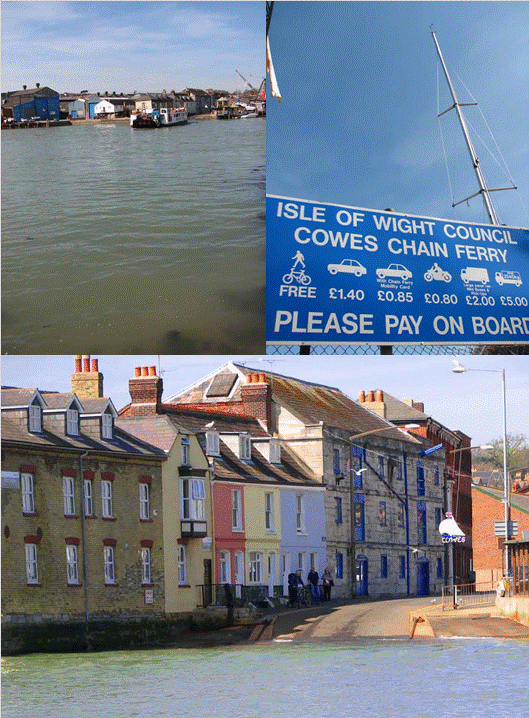


Our first walking day took us from Ryde to Cowes (13km). The first part of the walk took us past Quarr Abbey dating from 1131. Today’s buildings date from 1912 and are in a red Belgian brick. We stopped for coffee at Osborne House; not realizing that we would have had plenty of time to see the place today. Then we dropped down into Cowes, crossing the Medina River with the little chain ferry. Cowes is a lovely fishing village, which has been taken over by the ‘sailing set’. It bustles with life and looking out over the Solent, one can see many south coast towns with their busy ports. Traffic in the Solent is constant, with every type of craft sailing up, down and across.
Our second day took us on to Yarmouth (26km). We had to walk a little inland as part of this coastline is riddled with various river mouths. It was very interesting, nevertheless and we stopped for lunch near Shalfleet Mill. Our landlady had provided us with some sandwiches, so imagine our surprise when we discovered spam in one round and tongue in another. As the b&b was above an antique restorer, perhaps it was no wonder! When we reached Yarmouth we found another busy but smaller town. The ferry to Lymington arrives here, and was busily to-ing and fro-ing with day trippers.
The following day we had another long walk from Yarmouth all the way to Brighstone (23km). This took us down the west coast of the island, sometimes scrambling over areas where the path had collapsed down the cliffside. Our first views were of Hurst Castle (1544) seemingly almost touching distance away, across the water. This is one of Henry VIII fortresses protecting the Solent and the south coast ports.

We left the busy Solent behind us, with the Poole Bay opening out to our right. Ahead of us, we caught glimpses of the Needles jutting out into the sea beyond Alum Bay, and soon found ourselves descending into the resort area. We stopped here for coffee and then climbed up onto the chalk downs for good views of the Needles and back into the bay. This view showed us the different rocks that provide the coloured sands that have fascinated visitors for eons. We now walked up onto the downs, following the path to the Tennyson Monument where we stopped for lunch.

The weather was glorious, and it was a joy to be walking along in the clear air, with sea sparkling below us. At one point there was a very strange phenomenon. Looking out to sea, we could see a ship on the horizon, which appeared higher than we were on the cliff. Our route took us along the cliffs, negotiating the various chines that cut into the cliffs. Chines are the remains of ancient river valleys, now mostly small gullies leading down to the sea. The term "chine" is only used on the Isle of Wight and parts of Dorset and Hampshire. As the walls of the chines and cliffs of the south coast of the Isle of Wight are so unstable and erode continually, the strata are clearly visible. Chines are therefore very important for their fossil records, their archaeology and the unique flora and fauna they provide shelter to.
Walking day four had us tramping from Brighstone to Shanklin (24km). This section saw us reaching the southernmost point of the Isle of Wight, St Catherine’s Point. Actually, we saw the point from Gore Cliff as we turned the corner to begin the trek up towards the east coast. The waterways here seemed very quiet after the Solent, even the seabirds seemed in short supply. It gradually became busier as we came first into St Lawrence, where we descended onto the seafront. We walked on through passing the picturesquely named Woody Bay and Orchard Bay until we came for the signs for the Botanic Gardens. It was here that we had decided to have lunch. Arriving a little late, the choices were a bit limited, but it was very pleasant to have a seat in the gardens and to enjoy the sunshine. The new visitors centre is an impressive building with views out over most of the gardens. If one has plenty of time to explore, you can visit gardens from Japan and New Zealand to the Mediterranean and the Americas, not forgetting the Palm Garden.

We now pressed on along the path through Ventnor. This is quite a holiday town with hotels and attractions along the Esplanade. Coming away from Ventnor towards Shanklin, we walked through a wooded area at Bonchurch, passing the old church and the rock formation known as the Wishing Seat. This lead on to the area known as the Landslip. This area rests on the blue slipper layer of Gault. After a wet winter the rocks above the clay layer slide off causing the landslip. The path tries to keep well away from this area, with difficulty, but we had some lovely views along the coastline to Shanklin in the distance. Eventually we came to the steps down to Appley Beach, and the Fisherman’s Cottage Pub.  It was only a short walk now into Shanklin, back up the east cliff and into town and our Hotel. Contrary to our belief, the hotel was without a restaurant, but after restorative showers, we wandered downtown and were very lucky to discover a wonderful restaurant, The Cottage, on Eastcliff Road. They served us a superb meal and delicious wine. If the showers were restorative, this meal was elating. We floated back to the hotel for a delightful nights rest.
So, now it was our last walking day. This was Shanklin back to Ryde (22km) we began by walking along the cliff, then we soon came down into Sandown – down steps and a steep slope. We walked along the Esplanade and past the pier and the zoo at Yaverland where we climbed up to the cliff top again. It was lovely walking up on the cliff, but there are many holiday places, scattered along the routs. We descended at Bembridge and came to where there is a Lifeboat Pier, and a pleasant coffee stop. Bembridge has a huge harbour we had to walk around and we had to cross the River Yar. This is a bit confusing as we had been in Yarmouth on day 2 – so there are two river Yars on this small island. We made good progress and stopped in Seaview for a tasty sandwich for lunch. The Copper Kettle café, on the High Street is run by a young man, who makes exceedingly good sandwiches. We now had only a short walk in to Ryde – all along the coast, passing all sorts of attractions for visitors. But best of all we were able to walk along the beach for part of the way. Ryde was a Victorian resort, although today it has all modern facilities. The old Victorian Pavilion has been preserved and still offers a variety of amusements for visitors.  But we still had to walk to Binstead where we were staying. The route took us up through the town to the golf course and along the footpath, cutting through its middle. We then descended to Binstead church and finally into Binstead, and along to our b&b.


 We had closed the circle, and although tired, we were pleased with our achievement. The next morning we were driven back to Ryde, the ferry and then the train home.


Thursday, March 15, 2007

Ice Hotel Holiday 2

We were woken the next morning with a warm mug of lingonberry juice. Then it was time to reverse the routine of the previous night, handing in the gear, and dressing in warm clothes to brave the outdoors on our way to breakfast. We had arranged for us all to join an ice-sculpting class in the morning. So we made our way to the tepee by the river, where our teacher greeted us with a French accent. He told us that he was the designer of the Hammam room in the hotel, and spent some time up here each year. We each had a block of ice set on an ice column, which we were going to carve. He demonstrated the use of the tools, then turned on some suitable music, and let us exercise our imaginations. It was wonderful to see how everyone came up with interesting ideas to make from their block of ice. More lingonberry juice sustained us, and the morning just flew by. We wanted to take the English language tour of the hotel at 11.30, so off we went and walked around with a guide who told us about this year’s designers as well as the history of the hotel.

 We were also able to visit the wedding chapel, a great venue for that occasion. There were a few people about who were obviously dressed for a wedding, and we saw brides in wonderful Snow Queen outfits. A really romantic setting for tying the knot! We decided to walk down the road to the Homestead Restaurant for lunch, which was a bit further than we had imagined, but we had delicious sandwiches and coffee, before returning to move our bags to the warm Nordic Chalet for our second night. We all took showers, before our evening Northern Lights snowmobile adventure.
Our guide explained what we were going to do, and took us off to kit up in appropriate gear including balaclavas and helmets. We then paired up on the snowmobiles. I was lucky to be able to ‘drive’ one. With the senior guide in front and another two interspersed between us we set off, rather tentatively at first, but gained confidence all the time. At our first stop, the guide told us that she was sure we were going to see some Northern Lights activity as she could see something appearing on the horizon. This looked like some grey clouds, but then, what did we know? Off again, following her rules of keeping inline and keeping up; but then suddenly the man in front of us veered off to one side, ploughing through the thicker snow, then swinging across our path to the other side, eventually coming to a stop, so we sneaked slowly by him as did the others. Our guide stopped again, and our ‘friend’ who went ‘off piste’ was put up front behind the guide. The Northern Lights were beginning to build up, but we set off again. More ‘off piste’ driving ensued, so when we stopped again, the culprit was put behind one of the other guides – no more driving for him! The Northern Lights were really putting on a display and so D, with his pro camera set up some long exposure shots. At a minute exposure, he was getting some impressive photos - laughinggeo.blogspot.com .  Other people were actually using flash in an attempt to take a photo! This simply does not work. We just sat back and took in the amazing sight. It is like nothing else, as if the sky is alight with green fire, with a hint of purple. We set off again, this time to the circular log cabins where dinner was cooking for us. We filled up two, and the guides served us moose stew, with apple cake and custard and tea. All the time, the Northern Lights were performing, and D had his camera on the tripod taking automatic time lapse photos, which have proved an immense success.

 Now it was all over and it just remained for us to motor back along the river to the Ice Hotel. What an evening it had been. By the time we got back to Jukkasjarvi, we couldn’t see the Northern Lights any more – just the wrong outlook, and too much light pollution. But we had seen them and they are everything they are reputed to be. We just had to go to the Icebar to talk about it. Then it was bedtime in our cosy chalet.


Our last morning, and we were all packed up ready to leave in time to meet Bjorn our guide to Moose Spotting. He is a great bear of a man with a rather old minibus, in which we were to drive on a moose safari. He drove us and all our bags off to look for moose, regaling us with stories and asking us about where we came from and other travels we had been on. We soon reached the area where we could see moose and it wasn’t long before we started to spot them in the trees, or lying in the snow. Bjorn was quite concerned as many of the calves had been lost this year due to the moose not being able to find enough food under the snow. Nevertheless we saw 15 moose, before stopping at Nikkaluokta for a coffee. From here we had a fabulous view of the mountains of Kebnekaise, where one can tour – either on skis, or on foot in the summer. It is very close to the Norwegian border and the Sámi areas span the border. Now all that was left to do was to drive to the airport and get on the plane home. We all flew to Stockholm and then caught our different connections home. It was a fabulous few days together in a true paradise. Next year it will be different – and so was last year, so it was also truly unique.


Wednesday, March 14, 2007

Ice Hotel Holiday 1


Imagine staying at a brand new hotel that was built for the season, with designer rooms, a bar and even a wedding chapel; and at the end of the season it will literally melt back in to its natural surroundings. This is the famous IceHotel at Jukkasjarvi in Sweden, built from ice from the Torne River. The word Jukkasjarvi means meeting place in the Sámi language.
We went there for a family gathering in March, the season runs from December to as far into April as possible. The holiday began with us flying to Stockholm from various points of the compass. By the time we had all arrived it was too late to fly up to Kiruna, the airport for Jukkasjarvi, so we made our way into Stockholm for the night. Our hotel, The Strand, was on the harbour side, and after settling into our rooms, we met downstairs for dinner. The restaurant is in the atrium with chandeliers suspended in the middle of the space. There were also many lovely photographs on the wall as well as a triptych of the Stockholm waterfront. Our food matched the quality of the décor, and we enjoyed the family company after some months apart. We retired to bed after a short walk along the harbour wall, taken instead of coffee.


The next morning, we breakfasted at a reasonable hour, then walked along the harbour, eventually turning into the old town by the palace.

Our taxi was due at ten and we were soon on our way to Kiruna. We made sure that down jackets and hats were to hand when we landed as Kiruna is two hundred kilometres north of the Arctic Circle. We took the bus to Jukkasjarvi, and were swept off immediately on arrival to visit the Sámi encampment just down the river. The young Sámi people still practise the traditional life of reindeer herding; but also enjoy showing the tourists a little of what that means. In fact Jukkasjarvi is in the Sámi village of Talma, one of fifty two reindeer herding communities in Sweden. We tried lassoing some fairly docile reindeer with little success – only managing to get close to a stationary male. Luckily there were several Sámi people around, who organised the reindeer into harnesses attached to sleds. After one demonstration, pairs of us were sent off round a circuit, racing our sleds against each other. This involved yelling madly at the reindeer while slapping the reins across their backs. Their fur is so thick, that they can hardly feel a thing. Anyone with the slightest inhibition negotiated the track at snail’s pace, so those shouting their heads off got the fastest rides. When all this excitement as over, we were invited into the tepee for a warm drink and a snack. First came the warm lingonberry juice, which was tangy and refreshing, and while our host described what went on in the tepee – day to day life of working, eating and sleeping, he started to cook reindeer meat on a huge metal frying pan over the fire that was burning in a stone fireplace in the centre. We were all lying on piles of reindeer skins arranged around it. He placed slices of cooked meat in local bread smeared with lingonberry sauce, and invited us to eat. What a delicious flavour, just the job after spending the afternoon outdoors. But soon we had to head back to the hotel – to find our rooms and get organised, as we hadn’t managed to check in before the afternoon’s event.

 We piled back onto the sleds being pulled by skidoos and were soon skimming along the frozen Torne River back to the IceHotel. As it is quite an attraction, people do stay in the area and visit during the day to look at the designer rooms etc. We were shown where we could store our things in lockers. We would spend our first night in ice rooms, which have just a bed in the room closed with a curtain over the doorway. Of course, it is always below freezing in the IceHotel, so the facilities - the showers and loos are all in the wooden annex, where the lockers are. Only when you are actually ready to go to bed, do you get your sleeping bag, liners and hat to take to your room. We couldn’t wait to explore, so we entered the IceHotel and began a ‘voyage of discovery’.
First we found our rooms, just the standard types that are rather like the inside of a small igloo. We had a double bed made from ice, with a slatted base, mattress and several reindeer skins. Floor level lights illuminated the room operated from a switch on the bed. But it was the central corridor that caught the eye, with its twinkling chandelier and ‘Jessica’ chairs all carved from ice. At the end, there was an etched block commemorating the tercentenary of Carl von Linne (Linneus), the famous Swede who invented taxonomy. There is also the flowering ‘ice flower’. The corridors off on the opposite side are where the designer suites are found. These are amazing and different every year as ice sculptors from all over the world are invited to come to Jukkasjarvi in November to create them. They take about three weeks to build, and are stunning. There are so many interpretations involving etching the pure ice as well as intricate sculpting and the subtle use of lighting. Screens, seats, tables, beds and much more make up romantic rooms within rooms, which are an art gallery in their own right. These rooms are a little more expensive, and people reserve them for special occasions.

Although there is a beautiful wedding chapel, we did see a wedding taking place in a particularly beautiful Art Nouveau room designed by Russian artists. There was a room based on a Turkish Hammam, another like a Gentleman’s Club, and one with a circular table and bench covered in reindeer skins so you could sit down without freezing to the seat. This was the technique used in the Absolut Icebar where predictably they served lurid coloured cocktails based on vodka, served in ‘glasses’ made from blocks of ice. You had to keep your gloves on here to avoid sticking to your glass. There were armchairs with low tables carved from ice; and ice pictures ‘hanging’ on the wall. All the designs could be see at the Ice Hotel website, but 2007 pages 'have melted away'.  I think our favourite was the Russian Art Nouveau.

Now it was time for dinner, which we had booked in the IceHotel Restaurant. This is not made of ice – a bit tricky with warm food in the necessarily sub-zero temperatures. But nevertheless, the lovely glass all round us was very ice-like. The drinks glasses, glass candle holders and so on reflected the warm low lighting, with a special ambience. The food was outstanding. Feeling quite replete, we walked across to the Icebar for a nightcap. Did I mention lurid drinks? These were rainbow coloured and fairly strong cocktails served in the blocks of ice with hollowed out centres. You shouldn’t miss this very jolly experience. Well fortified, we went across to the annex to change into thermals and complete our ablutions. Then we collected our sleeping gear, which included hats and snow boots, and made our way to our rooms. We snuggled into the lined, down sleeping bags, and hardly a page was read before the eyes started to close and we snuggled deep into the warm bedclothes for a good night’s sleep.

Ice Hotel

Tuesday, February 06, 2007


Look who dropped in this morning!! Although these parakeets often fly over our house, today is the first time one has dropped by for a sunflower seed or three! It gave the magpies something to think about. They had only just recovered from a visitation from the sparrowhawk when we were counting birds for the RSPB garden bird watch.


Sunday, February 04, 2007

South Africa Part 4


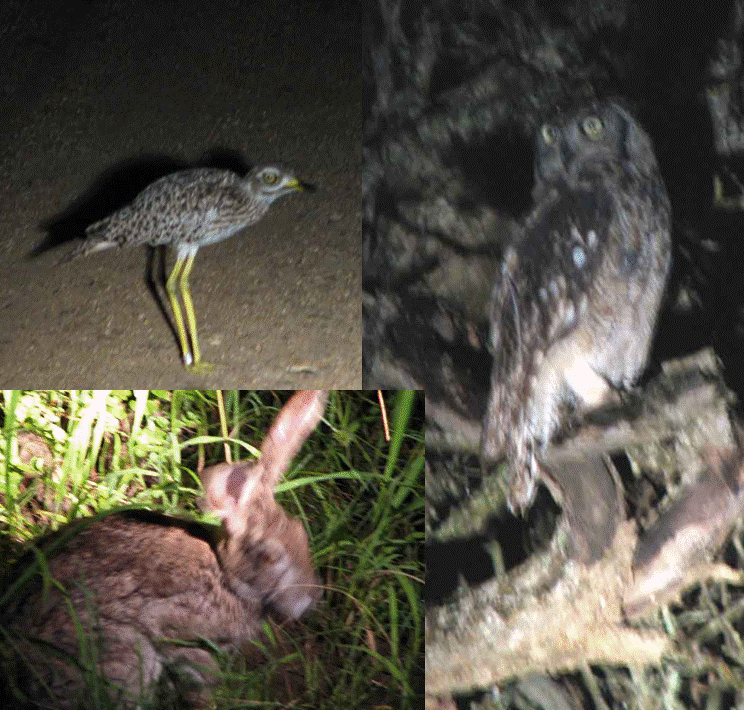
The last part of the journey now began as we headed for Makuze Game Reserve, where we hoped to see the black rhino. We set up our camp in rather wet weather and the first group went off for an evening game drive. We had a restful evening, preparing us for the early game drive the next morning. On this we saw lots of birds, over 420 recorded species inhabit the reserve; also many buck, including impala and nyala. The first thing we saw was the black rhino, appearing rather shy! On our evening drive, it was very wet, but the stone curlews were still out in numbers along with other nocturnal animals. Our surprise was a porcupine, which dashed across the track in front of the safari jeep! And so the long drive to the Drakensburg began early on our thirteenth day.


We stopped at Talana, where there is a museum commemorating the first battle of the South African War. The open air part of the museum, showing the town and its dependency on the coal mines was very interesting, too. But before long we were on the road again, with the promise of the Drakensburg beckoning us. Soon, the plains gave way to the mountains, and glimpses of the Amphitheatre, a crescent shaped basalt wall some 1500m high. We stayed in a permanent tented camp with views down the valley. Baboons are known to occasionally charge through the area, but we only saw them on the other side of the valley. Again, it was pretty wet, so the view came and went.


Our first day was a walk into the valley at the bottom of the Amphitheatre. We managed up to the river crossing; but it was much too deep and fast flowing to get across. Nevertheless, we saw some lovely plants and flowers. Our day ended with a walk up to the rock drawings made by the San Bushmen, which are ancient and very precious. Our last day before beginning the journey home via Johannesburg, was taken up by the trek up to the plateau on top of the Amphitheatre. This involves climbing metal chain ladders slung over vertical rock faces. But the climb is very well worth it as the views from the top are beautiful. If you look carefully at the photos, you may see the elusive hyrax in the rocks. We only got this glimpse, as they fled into deep cover as we arrived. Other delights were the flowers – iris and orchids to name but a few, and a lammergeyer, which flew down one of the gullies as we were leaving the plateau. What excitement!


On our way back to the camp we spotted a family of beautiful crowned cranes delicately picking their way across the fields - a lovely sight.

Saturday, February 03, 2007

South Africa Part 3


The third part of our South African trip took us into Swaziland through the usual border checks, which were carried out with great efficiency. We rejoined our van across the border and began a spectacular drive up into the beautiful hills. We stopped for lunch at Piggs Peak where there is a lovely craft place with an award winning shop selling silver and sisal jewellery and fine houseware. We stayed in a stunning 'village', Hawane, where the cabins are made in a psuedo-traditional style. They are a wonderful combination of traditional building and innovative luxury! We were very comfortable there. A days trekking in the Malolotja Nature Reserve brought us the rewards of fabulous panoramas, wild flowers, waterfalls and the elusive biesbok. Once again our drivers and chief guide cooked for us. This time it was in the backpackers area of the village - and was just as good for that!
The next day saw us back in the van again, heading through the capital, Mbabane and on to a kilometer long craft area at Mbabane, where we stopped and bought traditional crafts. The rest of the day was a drive to Mkuze Game Reserve and this is the next part of the trip.


Friday, February 02, 2007

South Africa Part 2

After walking in Mpumalanga, we headed for our first game park. This is Edeni, a private park, where we set up camp and took several game drives and a walk in the wild! We then moved on to Kruger via a reptile sanctuary where the agamas like to eat hibiscus flowers! Camping again, we drove into the wild areas to see some fabulous wild animals.


Thursday, February 01, 2007

South Africa Part 1

Our holiday in South Africa had several phases. This is the start when we visited Mpumalanga, the Blyde River Canyon and Magoebaskloof. We stayed in hikers cabins, cooking over open fires and as you see in one place we had a camp shower - with hot water - luxury!


Tuesday, December 12, 2006

11th December - A Celebration Day


11th December and celebration time. We combined a birthday and a wedding anniversary to have a mystery day out. Beginning with a coffee at Maison Blanc, a present was given and received with surprise and delight. Something to take on holiday later on.

Then home to change into something smart to take us to dinner in Mayfair much later. We caught the train to London and walked over Hungerford Bridge to the National Gallery and their superb Velazquez Exhibition. We enjoyed the audio commentary - after first turning the volume down as we were initially deafened!

By the time we emerged, it was dark in Trafalgar Square and the Norwegian Christmas tree was looking majestic. Carol singers were performing in its shadow and the evening felt brisk. We retraced our steps to the bridge and crossed back over River Thames. We were heading for the London Eye and a champagne flight! We shared our gondola with six others and enjoyed Laurent-Perrier champagne as we circled high over London. The clear night gave us fabulous views to the outposts of the capital! This is such a fun thing to do - I must try it in daylight, too!

We descended all too quickly, and then needed to find a taxi. Probably the best place would be Charing Cross - the right side of the river for our next destination.

Soon we were being driven across town to Grovesnor Square and our destination - Brian Turner Mayfair. Brian Turner is a Michelin star chef who cooks delicious British food in his own special way. We studied the menu over a small glass of chardonnay in Turner's Bar, then moved through to our table. Our starters were Aniseed infused Rolled Duck Pancake with Pear Dressing and Broad Beans, and Cray Fish and Crab Cocktail with Seaweed and 'Horseradish Caviar' (this was pale green and popped in your mouth in a very satisfactory way!

Main courses were the same - Finnebrogue Venison loin, Potato and Parsnip Terrine,Pear Relish and Chocolate. We had some red cabbage and broccoli, too. And we also had a wonderful bottle of 2001 Brunello di Montalcino, which complemented the richness of the venison, admirably. After something of a pause to allow our meal to settle, we chose our desserts - Soft Centered Chocolate Pudding, "Jaffa Cake" Ice Cream; and Savarin of Pear Compote with Chocolate Ripple. Mmmm! Lovely!

Then there was just enough time for a cup of Earl Grey and a petit fours. The latter were served on a plate decorated with Birthday and Anniversary greetings - a great touch to end a memorable dinner. But just when you think its all over something else happens - and through came our chef, who gladly autographed his book 'Favourite Britsh Recipes' for us; and we were able to compliment him on his wonderful cooking. All that remained was to find our taxi home, and collapse into bed after an amazing day out.

Saturday, November 04, 2006

Squash Stacks


Last evening we ate these delicious Squash Stacks. I made them to the following recipe

A small butternut squash
250 gm cooking spinach
100gm Soignan goat cheese
Olive oil
Nutmeg
Salt and freshly ground black pepper

Serves 2

Heat the oven to 200C.
Cut the squash in half lengthways and remove the seeds.
Brush the cut surface with olive oil and place face down on a baking sheet.
Bake in the pre-heated oven for about 40 minutes until the flesh is soft.
Remove from oven and turn down to 100C
Then scoop out the flesh and roughly mash with a fork, seasoning to taste.
Keep warm while you cook the spinach.
Wash spinach thoroughly, place in a pan and wilt over a moderate heat.
Season with salt and freshly grated nutmeg.
Place a three inch ring on each of two warm plates.
Divide the squash between the two rings, pressing down firmly.
Pile the spinach on top, then remove the rings carefully.
Slice the goat cheese into rounds and place on top of the spinach.
Put the plates into the oven for a few minutes to just melt the cheese.
Serve immediately with some crusty bread.

We had a glass or two of Albarino, rias baixas to accompany this, which complemented it very well.

Sunday, October 29, 2006

Surprise d'Halloween


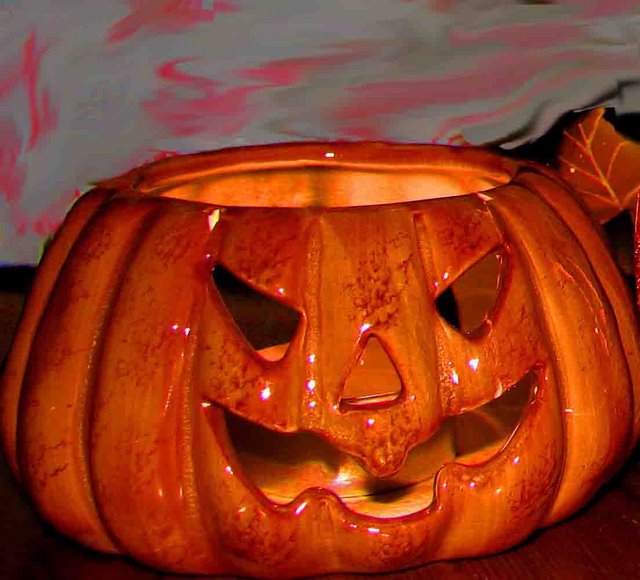
This gorgeous dessert came from our local French patisserie, Maison Blanc. Its rich, orange chocolate, pumpkin shaped case is filled with the most delicious truffle topped with squirls of dark chocolate. These are serious desserts - death by chocolate springs to mind. You can't rush these, so take your time and indulge, if you can.

Pumpkin Soup


Last week we visited A Taste of Autumn at RHS Garden Wisley. While there we tasted their delicious pumpkin soup and now I can blog the recipe.

Wisley Pumpkin Soup
700g Pumpkin, peeled, deseeded and cubed
25 g butter
100g onion, peeled and finely chopped
10g tomato puree
250ml whole milk
800ml good vegetable stock
salt and freshly ground black pepper

Melt butter in pan adding onion to fry gently until soft
Add pumpkin and tomato puree (for colour rather than flavour), stir and season
Cover and allow to sweat over a gentle heat until softened
Add milk and stock and simmer gently for 10 minutes
Blend to a smooth puree in a blender or food processor
Pass through a fine sieve; check seasoning and serve.
You could add a little panache with a swirl of yoghurt and a sprinkle of finely chopped parsley. Posted by Picasa

Friday, October 27, 2006

A Taste of Autumn


Friday to Monday last was RHS Garden Wisley's celebration of the season with their Taste of Autumn Fair. This used to be a simple apple tasting day with some activities for children, but like Topsy it has grown.
A marquee is erected on the lawn beside the new grasses border and a great collection of exhibitors are invited for the four days. There are activities for children as the dates coincide with autumn half term and this year a special trail through the autumn and winter trees was launched - the Barking Mad Trail!
Alan and I went to visit TOA on the opening morning, early. We know that Wisley events are very popular and get busier and busier as the day wears on. We arrived in a really heavy rainstorm - even running to the coffee shop wasn't an option for ten or fifteen minutes, but eventually we did get our cappuccinos before we entered the garden. Luckily the rain had cleared completely and the sky was blue-ing up nicely as we walked passed the Laboratory. Just by the front door is the apple mosaic, which this year is a lovely lion with a lopsided face and an impressive red mane. A children's competition is held annually for the design of the mosaic.
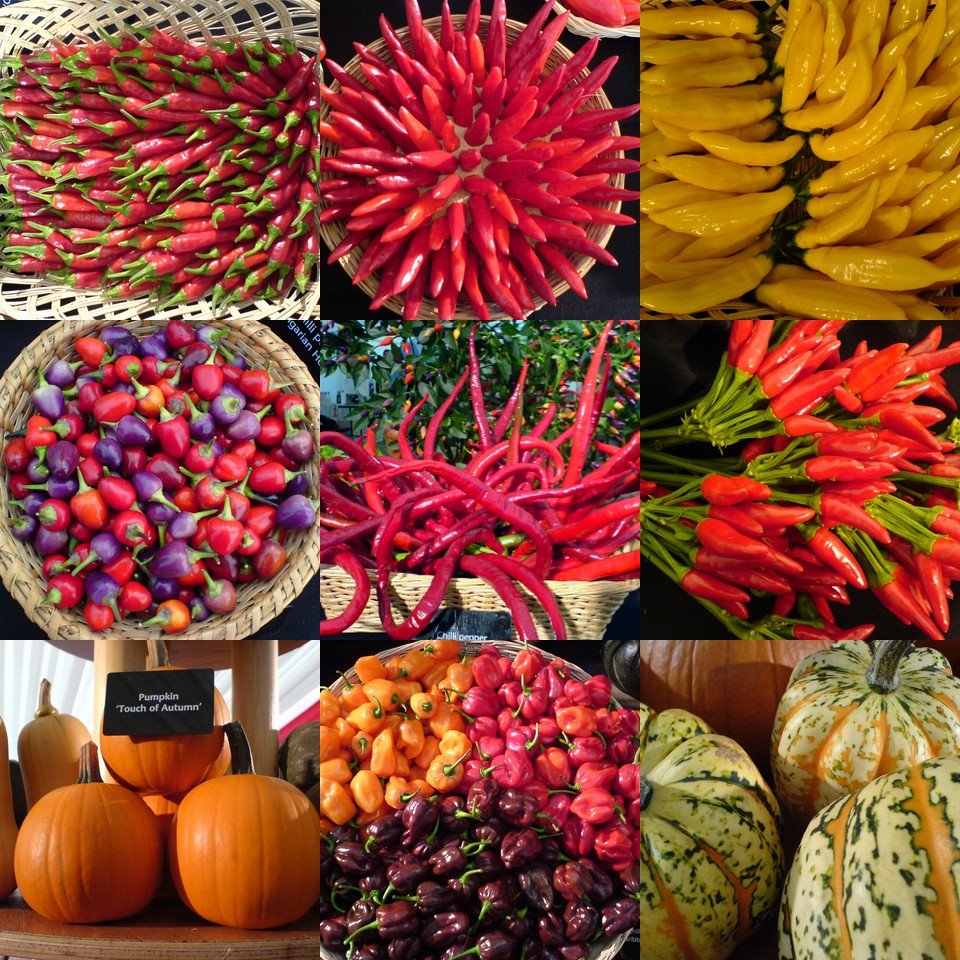
The entrance to the marquee was round the corner near where the advisory service and library are situated. We joined the small crowd heading up the walkways across the grass to enter the marquee. A wonderful sight greeted us, as the trials department had put on a wonderful display of chillies and pumpkin type vegetables. It was so colourful and quite surprising to see the vastly different chillies anyone can grow at home. Not just the classic red supermarket variety, but spikey long ones called Pinnocchio, colourful small ones ranging form pale yellow to red and purple, minute red ones, long thin yellow ones. The pumpkins were also surprising; not just Halloween carving ones, but small stripey ones - one called Pyjamas; and another small variety called Microwave. I wonder if you can just microwave it whole! In the centre of the area was the apple tasting table. Here some of the staffof Wisley were busy cutting up samples of the varieties of apples grown in the orchard for visitors to taste. This is a very popular stand, as everyone loves to try the apples. Some even decide to grow their favourite variety; after first checking that they have the correct conditions for growing it. The advisors are on hand to help with this.
Apart from the several RHS displays, around the marquee were the stalls of the exhibitors. These are all apple or autumn related - apple juices, cider, jams and preserves, cheese, wine, nuts and seeds. There was an area set up for demonstrations, and we were able to attend one of these. The first demonstration on Friday was from the Good Housekeeping chefs. They cooked pigeon and duck salad, with caramelised apples. The aromas were mouthwatering and we gladly complied with the chef's request to come up and taste their efforts. Delicious!
This wasn't our only tasting! As we walked around, many of the stalls were offering samples, which were irresistable and we just had to buy jam, wine, apple juice and more. One stall was roasting nuts and another toasting seeds and yet another was cooking vegetarian sausages. There was even a tureen of pumkin soup to sample. So you can imagine the marquee filled with tempting odours.
In a separate area, children's activities were getting underway. Here the young ones could draw apples, write a wish and hang them on the Apple Wish tree as well as carve pumpkins for Halloween and other crafts - what better way to spend and hour or so. And when all the 'in tent' activities have been exhausted, there were guided walks around the Fruit Field. Once again RHS excelled and I'm sure all who visited A Taste of Autumn over the weekend had a wondeful time.
There will be the Crafts for Christmas Fair 21st -24th November as well as a visit from Father Christmas nearer Christmas, and the shopping weekends at the Shop and Plant Centre before Christmas. So plenty to do and see at RHS Garden Wisley.

Friday, October 06, 2006

Royal Botanic Gardens, Kew

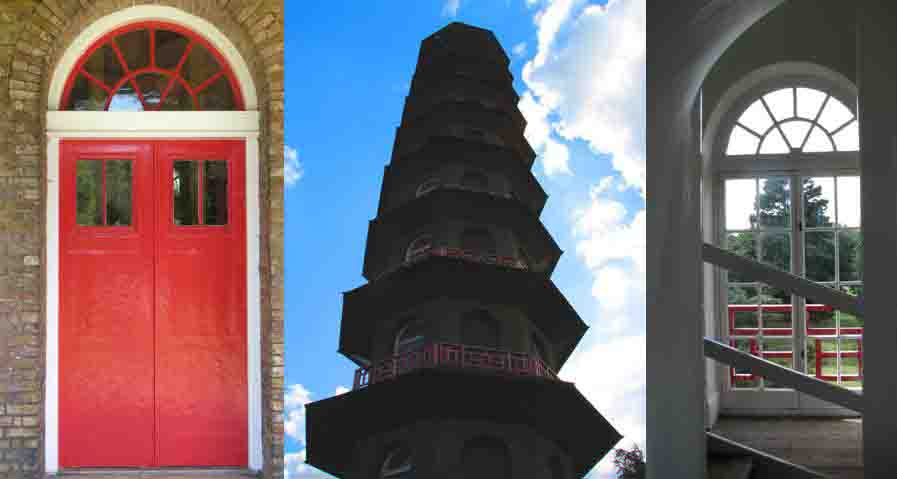
The Pagoda at Kew was designed by the famous architect William Chambers; completed in 1762 it was the tallest reconstruction of a Chinese building of its time in Europe, nearly 50 m and having 253 steps. The ten-storey octagonal structure tapers, with successive floors from the first to the topmost being 30 cm less in diameter and height than the preceding one. The original building was very colourful; the roofs being covered with varnished iron plates, with a dragon on each corner. There were 80 dragons in all, each carved from wood and gilded with real gold. Although there have been several restorations, mainly to the roofs, the original colours and the dragons have not been replaced, even though replica dragon were discussed in 1979. In 2006 the Pagoda was opened to the general public for the first time in recent memory. Those who climb its 253 steps are rewarded with spectacular views across the gardens and across London, with the London Eye, the new Wembley Stadium, and as far as Canary Wharf all visible.

Royal Botanic Gardens, Kew


Another new innovation this year is The Sackler Crossing, open 17 May 2006. It is designed by architect John Pawson and spans the lake at the western end of the Gardens, contributing to a new route through the Capability Brown landscape, and providing the first passage across water on the World Heritage Site.

Monday, September 11, 2006

Goodwood Revival 2006


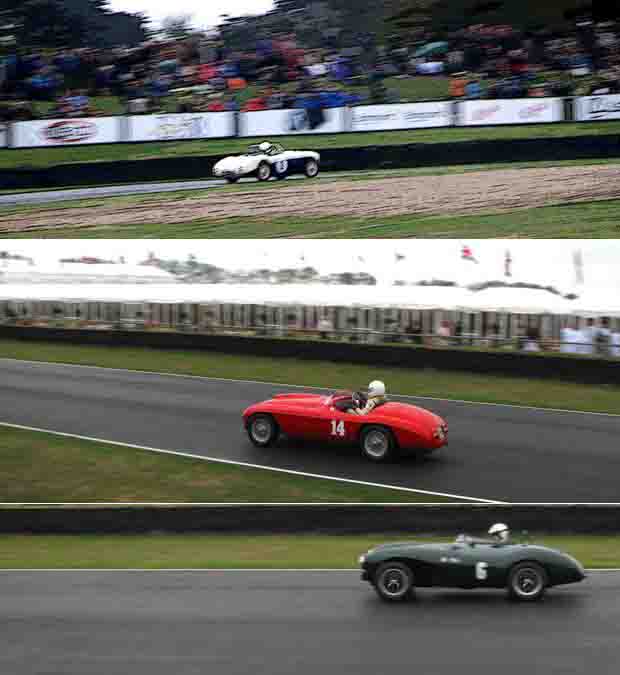
For three days each September, the Goodwood Motor Circuit stages a historic race meeting for the kind of cars and motorcycles that would have competed at Goodwood during 1948-1966. Many famous people in the world of motor racing compete in period cars from that golden age. As the world's most popular motor race meeting, it is an amazing sight to see so many of the spectators dressed in the clothes of the era - girls emulating the glamourous stars of the time, young men in uniform, flat caps and sports jackets, as well as teddy boys and bobby socks. Vehicles are shown off with polished chrome and gleaming bodywork whether they are vans, emergency vehicles, trucks or sports cars. There is such a variety. There are also races everyday culminating in a grand finale on Sunday. Each year there is a tribute to a specific era. This year, 2006, was the featured cars were the microcars of the nineteen fifties. Unbelievable how small they were.
It has just been announced that ITV1 will air its programme about this year's festival on Tuesday, 10 October 2006 at 23.00. Don't miss it - it will be a treat!
Further information about Goodwood Revival meetings can be obtained from the Goodwood website.

Friday, September 01, 2006

Philip Jackson

Philip Jackson is a sculptor. Born in 1948, he was chosen to create an equestrian statue of the Queen for her Golden Jubilee, which is to be found in Windsor Great Park. Another ‘to become famous’ piece will be the twice life-size statue of Bobby Moore which will be unveiled at the opening of the new Wembley Stadium. These photographs were made at his exhibition at West Dean Gardens, close to his home in Midhurst. Posted by Picasa