Saturday, May 30, 2009

Wicklow Weekend, Saturday

We met for breakfast on Saturday morning – a feast of home made delights and mostly local produce. After Ballyknocken cereals we had French toast or drop scones with nuts and syrup or a full Irish breakfast for one brave lad.
Our first day was spent around the Military Road, starting with Glendalough. On the way there we passed through the highest village in Ireland, Roundwood (238m), which seemed quite popular with the tourists. We found a space in the busy car park at the Glendalough information centre and then followed the path to the old monastic settlement. Founded by St Kevin in 6th century, this is an important site set at the head of a valley containing two lakes. It was sacked by Vikings many times, and then partially razed by the English in the late fourteenth century before falling victim to the Dissolution, 1539. Even so, pilgrims still visit the site especially on 3rd June which is St. Kevin’s Day. Some restoration took place in the mid eighteenth century, but most of the buildings date from between the eighth and twelfth centuries. We walked around the area and then followed the river down to the first or lower lake and back as we had to be on the move again.


 Now we followed the road back and on towards Powerscourt House with its magnificent gardens. The house was a Palladian mansion of considerable size dating from the early eighteenth century and built on the site of a Norman castle. Sadly it was gutted by fire in 1974 but has been partially restored to provide cafes and shops for visitors as well as an exhibition about the history of Powerscourt estate. Luckily the gardens remained intact and are beautifully kept.


We wandered through all the areas, including the Japanese Garden, around the Triton Lake, Dolphin Pond and the wonderful walled garden. There are lots of statues in the Italian style (e.g. after Bernini) which reminded some of Angels and Demons! From the terrace there is a good view of Great Sugar Loaf (501m), made from Cambrian quartzite, it forms a volcanic like cone above the surrounding hills, which are Devonian granite. We decided to have a little late lunch in the café before moving on to the highest waterfall in Ireland. Powerscourt Waterfall falls 130m, and we think that is the height referred to, but it could be the highest in elevation, too.


Reading the guide book, we understood that this was an idyllic area to visit where Sika deer may be glimpsed among the trees and bird spotting was a delight. We were not prepared for the sight that met us – a valley full of cars, picnickers and barbecue aromas wafting across to us. It was awash with people, all enjoying the lovely weather and the beautiful area. The waterfall is lovely as it cascades over the rocks, and many people were enjoying a dip in the pool at its base – albeit a bit cool as it was in the shadow of the rocks. Needless to say, the Sika deer were long gone and only a few sparrows and starlings were to be seen.
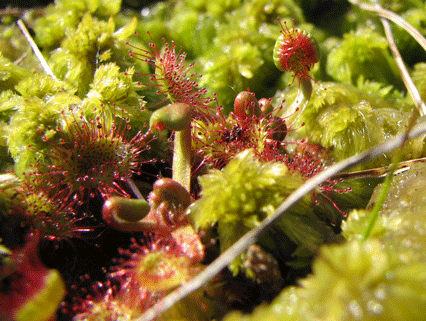
We had also read that there were sundews to be found around a place called Sally Gap, so this was our next stop on our circuit of the Military Road. The roads are fairly narrow and winding, so we had to find a pull in so we could search for them. We stopped to look at some deer some way from the road and M went off on a reccy. And there in a boggy area she found loads of sundews, which we all saw and photographed. And even though we stopped another couple of times, we just didn’t find that many again. That was a good and lucky find. So we had to get back and change for dinner at seven. This was at Ballyknocken House – from the kitchen of Catherine Fulvia, so we needed to be ready to do that justice.
At seven we were served dry sherry in the sitting room. There were several other people staying at the house including a Belgian family, some Americans and a couple who were attending the cookery course on Sunday. The wife came from Milan, so was very interested in Catherine’s style of Italian cookery. We went through for dinner after Catherine came and described the meal. We started with antipasto, followed by a potato and lemongrass soup with parsley oil, which was served with Mary’s Brown Bread. Then came sage stuffed pork with carrot and cumin puree and apple slices and a dessert of pear and polenta cake with a strawberry stack. With the meal we drank a wine from the Ardeche estate Mas de Libian, Bout d’Zan. Coffee and tea were then served in one of the other rooms, and we gathered round a table with a hilarious game of naming things beginning with a letter chosen with the roll of a die, which ended in hysterical laughter! It was time for bed.


Friday, May 29, 2009

Wicklow Weekend - Arrival

At the end of May it is D’s birthday and we are often all together for the celebration as it’s around Bank Holiday. This year was to be no exception even though he’s away in Norway. This was secretly arranged by S, who invited us all to meet up in Ireland for a long weekend and we all went along with the surprise, booking tickets and finding out about things to do in Co. Wicklow and Dublin.
Friday came and A and I set off for our flight – arriving some time ahead of the birthday boy so we could surprise him as he and S came through. His face was a picture and S told us that until they were on the plane to Amsterdam, D didn’t have a clue where they were going nor did he have any idea we would be there. Priceless! We waited for M and N to arrive then drove off in our hire car for Wicklow town for a late supper of tapas in Al’s Bar. This was delicious and although we were the sole occupants of this little café, it was great fun. Then we found our way back to the guest house.


We stayed at Ballyknocken House, which has its own cookery school attached. Here TV chef/owner Catherine Fulvio holds cookery classes in all sorts of cuisines. The rooms are all beautifully appointed with ensuites that have huge Victorian baths which have showers in them, so if you go hiking there is the promise of a good soak when you come back. The views are lovely, either over the mountains or out across the rolling farmland towards the coast.

Ballyknocken House information

Wednesday, May 27, 2009

Tuesday, May 26, 2009

Monday, May 25, 2009

Surrey County Show

Bank holiday Monday and its the Surrey County Show. As we are now within walking distance, we decided to make our first visit to one of the last traditional county shows still being held in England; and there was also the promise of a great day, weatherwise, with the threat of rain only after six pm.
As the rain may come later, we started early, getting to the entrance soon after ten, There was already a lot of people there, but we could wander through the livestock tents and see some wonderful animals, quite easily.
Then it was time for a break and we went off to find some refreshments. We got pastries to go with our coffee in the food tent, which was packed with local producers, selling their delicious wares. Some of these we remembered from other 'shows' around the county, and some from the local farmer's markets.


We sat by the bandstand, and just before we finished, the band came marching in - the British Legion Band, and they squeezed in to the bandstand with scarcely room to play their instruments. They were dressed in smart uniforms, and were mostly young people, really enjoying themselves.
Just round the corner we found a display of antique farm equipment. All of them have been lovingly restored and were working away, puffing out steam.

There were demonstrations of country crafts such as sheep shearing (by hand) and wood turning.There was a falconry display as well as morris dancing when the Pilgrim Morris Men got loads of young folk up to have a go, which was great and they really had a fun time! There were even some angora goats in their own special tent with some goods made from their wool to buy.
Our next stop was one of the display rings. Here they were judging the donkeys and their owners, followed by the donkey carts, which were put through their paces, showing how smart they were as well as how well they were turned out. Some needed a bit of practise, but the winner looked like a seasoned campaigner with driving skills and turn out to match.

By now it was very warm, with the sun beating down, We went in search of ice cream, which we took into the shade of some trees. Just beside us was the mole catcher - with his catchy slogan! (Making it safe to go back on the lawn.) Then we walked past the roundabout with its lovely horses and gaudy music, past lots of tents selling everything from wellies to jewellry until we spotted the sheep show. Here a New Zealand chap was just starting his show from the trailer of his huge truck. The stars were several different breeds of sheep, which he introduced with a brief history - very tongue-in-cheek! Then he sheared a sheep for us; played some music for the sheep to dance to, and that was it. It was quite hilarious and he attracted a huge crowd of folk and a huge round of applause at the end.
After this light entertainment we walked around the ground to try and get a view of the main ring, which is quite difficult when the stands are full and the other area where you can look over the fence is thronged with people. We found a bit of a view near the entrance gate and saw the last of the prize cows walking around the field. Then from here we could see some of the double harness scurries that were competing around the driving course. It was fast and furious and the main sponsor was competing for a place in the finals. He got through with two pairs of horses, along with several others whom we would eatch a little later.
In the interval we had a demonstration by the monster trucks, which sped about the field, charging across it a diagonals over some wrecked cars. Unfortunately for us, the organisers parked some extra cars across our view, so we didn't see much. Every diagonal charge was an attempt to get the vehicles airbourne, and at last the red one overturned. Luckily the driver was unhurt and the fork lift truck came on to right it again. Then we watched the finale of the double harness scurries, which was slightly delayed as one of the prize bulls, weighing in at over 1000kg, decided it was not getting into the truck taking him home. It bent some fences as stewards, owners and handlers tried to drag it to the truck. Eventually they managed to push the beast in and the show was underway again. The final got under way and then it was the finale in the main ring with the British Legion band leading the way.
The skies were darkening, but the hotair balloonists now entered the ring - and as many people were leaving, we moved up to a better viewing spot. We watched them inflate two of the balloons, but sadly the threat of a thunder storm was to great for them to take off, so now it really was time to go home after a really great day out.

Sunday, May 10, 2009

North Downs Way

Today we began the North Downs Way by walking the second leg from Guildford to Dorking. Why start with the second leg? Well, its Sunday and the usual track repairs have stopped normal train services and the buses don’t run on Sundays – we need to do the first leg when public transport is running!
We began with the well trodden path to Newlands Corner, and having dragged Alan away from the bacon buttie kiosk, we struck out on the new path, following the easily spotted finger posts.


We crossed the A25 and found ourselves on a wide path through the trees, soon leaving the sound of traffic behind, and tuning in to the cuckoo calling in the distance. It was very pleasant walking under the leafy canopy, and we came across the occasional clearing with views across the valleys with conveniently placed benches!


We refrained from a side visit to the Silent Pools, promising ourselves a dedicated walk there one day. It looked a precipitous downhill to the pools , which means a stiff climb back again, which is OK, but we reckoned on about 15 miles for the planned walk, and weren’t keen on adding too much more!
Once again, the pathways were lined with delightful wild flowers and the ferns had come on in bounds, showing off in great fans of fronds along the way.


At lunchtime, we came up to this hill top with its panoramic view and several benches, one being free for a welcome seat. The sheepdog, which sneaked into the picture, was having great fun creeping up on the ball its owner left in the grass just as if it was herding the sheep.


Our path was quite stony and there were plenty of butterflies flittering around us. So difficult to catch with the camera until this peacock landed on the path in front of us and settled to get his photo taken.


We were gradually meeting more people and soon came to the area known as Ranmore Common and the ‘Church on the North Downs Way’ (St Barnabas’s).


It seemed as though we were almost there, but we still had a little way to go, eventually descending the path to Denbies winery for a very welcome cup of tea. The vines are just coming into leaf and flower, so we hope that the flowers get pollinated and lots of baby grapes get set to make another excellent vintage later in the year.


Refreshed, All that was left was to walk down to Deepdene Station and a train back to Gilly. And those who wonder why we didn’t climb Box Hill – well, we’ve done that many, many times!!


Monday, May 04, 2009

Bank holiday walk

A bank holiday – and a great day for a walk; so we laced up the walking shoes, adjusted the poles, packed the rucksacks and set off with a map and a vague idea of a round trip of some 16kms. We began the usual way by getting up to Pewley Down, then across to St Martha’s Church.


At this point we walked round to the front of the church and took the path that plunged over the edge and down towards Chilworth.


Suddenly we spied llamas in the field and a lone one in a paddock close by the path – a sight to behold in the Surrey countryside.


We consulted the map and made a sort of left turn, hoping to connect with the Downs Link path. Soon we began seeing the signs and this path took us across Blackheath to skirt round the path up to Chinthurst Tower.


From here we followed the track taking us across the attractive double bridge (road with footpath at a slightly dropped level) and turned left to follow the Wey South Path going north. There were lots of dandelion clocks along the path some of which had shed their down to get caught in spiders webs. There were also some high altitude snails, like the ones we had seen in Smannell.


We found ourselves following the cycle route, but we could cut right just over a bridge, which brought us along the Wey to the Parrot at Shalford. We sat by the Navigation and had butties, then enjoyed a hot cup of coffee at the Parrot. The next bit was something like guesswork as there are several paths not all of which were on the map. But we managed to get ourselves to The Seahorse, another popular hostelry, and across the road towards the Chantries.


Our intention was to come onto Pewley Downs at the bottom of the woods, but we managed to climb right up into the bluebell covered woods, which were beautiful.


There was nothing for it, but to make our way up and over the ridge, eventually meeting up with our path to St Martha’s hill, turning left to retrace the start of our walk up onto Pewley Down and home.
We did get wet a couple of times, but the weather was very pleasant if a little dull and so it wasn’t too hot. The birds were singing all the way along and there were loads of lovely wild flowers to enjoy along the way. We even heard the cuckoo.


It was very good to be out and about with no worries of traffic jams or crowds. We met a few cyclists and a few horse riders as well as walkers on the way, but not in any great profusion. Lovely!

Tuesday, April 14, 2009


This evening we attended the performance of Lord of the Rings - The Fellowship of the Ring with LIVE soundtrack played by the London Philharmonic Orchestra conducted by Ludwig Wicki. Howard Shore's Academy award-winning score was performed live on stage by the original soundtrack orchestra and choirs, The London Voices and The London Oratory School Schola.
This was a birthday present and we have been anticipating this wonderful evening for a few months. We began with an early dinner at Carluccio's by South Ken Station, then walked up Queen's Gate to the steps leading up to the Royal Albert Hall. Many people joined us as we walked up, allowing ourselves to be impressed by the lovely building. We entered by door 11, to gain acess to the arena where we were to be sitting. This is where the promenaders usually mill about during the Proms season. Tonight there were seats, and we had a grand view of the podium with the big screen in position behind, covering the organ and its associated pipes.
The orchestra seemed pretty large and included several places for the percussion. This included a huge drum cradled on its side as well as bells, other drums and the usual percussion instruments. The choir sat behind the orchestra, just under the screen.
It took some time to get everyone seated as it was definitely a full house, but eventually the house lights dimmed and the conductor appeared. The screen flickered to life and as the opening credits rolled, the conductor brought down his baton and the performance began. It was stunning and we sat spell bound; watching the film; reading the subtitles; and watching the orchestra as the musicians created the magic with their expertise. Luckily there was an interval when we could stretch our legs, then the second half began and again we were fascinated by all the performances - trying to spot when the very large drum was used, but not wanting to miss the action on the truly big screen.
As the film drew to an end, everyone remained seated as the closing credits rolled up the screen - of course, the music continues right to the end, and then the whole of the Royal Albert Hall errupted into ecstatic applause. The audience loved the perfomance, and we said a very big thank you to the giver of this wonderful birthday present. A night to remember.

Wednesday, April 08, 2009

Hats, Hatchards and a High Street dinner

We thought we would go to the Darwin Exhibition at the Natural History Museum and set off for South Ken only to find that the queue to get in – just to the Museum, was down the steps, through the garden, passed the wildlife garden, out of the gate and up Queens Gate. It would probably take a couple of hours just to get to the front door. So, we decided to visit the V&A, next door, where the crowds were less dense!
Hats: An Anthology by Stephen Jones was our chosen exhibition, and we nearly got in for free with our Art Fund cards. It is an exhibition reflecting one by Cecil Beaton in the 1971 – in fact the V&A’s first fashion show. This exhibition is a collaboration between V&A and Stephen Jones, world famous milliner. He has been producing hat collections twice a year for twenty years as well as working with many famous fashion houses and designers. I find this quite interesting as Grannie trained as a milliner in Manchester in the 1930s at a well known milliners, Jones of Manchester.
The exhibition is wonderful, with hats in displayed in ‘shop windows’, grouped in topics such as Inspiration, Creation, The Salon and The Client. The displays included some very old hats – the oldest we saw being and apprentice’s hat from the 1550s, as well as Stephen Jones creations from this year. We saw some beautiful creations as well as some weird ones, but all were great fun and beautifully displayed. In the centre of the exhibition there is milliner’s workshop with shelves stacked with the tools of the trade, half made and finished hats. The visitor can see into this workshop through several windows, each giving a slightly different view – the wooden heads, the sewing machine, boxes of feathers, flowers and other accessories overflowing the work tables. There are hats you would wear to Ascot Ladies Day and others that graced the King’s Road in the 60s; Queen’s hats, star’s hats and hats for you and me! A really fascinating collection, and yes, I’m sorry we missed Mr Darwin, but I’m not sorry we saw this great exhibition.
To continue our ‘day out’, we made our way to Green Park tube station and walked down Piccadilly. Our aim was to browse around Hatchards Bookshop, but first we came to Fortnum and Mason and who can resist a look in the windows, and we just had to go inside.


After wandering around the food, we made our way upstairs to look at all those amazing articles one never knew you needed! But sense prevailed and nothing was bought! However, we came across a stand of Stephen Jones hats, which were duly photographed, as that was strictly banned in the V&A.


There is also a display advertising the exhibition on the staircase.


So Hatchards came next and we couldn’t resist a copy of The Return of John MacNab, having a John Buchan fan with us.
We had consumed most of the day, so we made our way to the train home and walked up the High Street from the station to enjoy a glass of wine in the bar of The Farriers before we had dinner in their bistro - Upstairs@the Farriers. It was a lovely way to end such a jolly day out.


Friday, April 03, 2009

Dancing at Lughnasa

I always wondered what Lughnasa was, when I read that the play Dancing at Lughnasa was being performed. Was it a place in Dublin – a bar or dance hall or club, maybe? So when we decided to sample the delights of another performance in the CQS space at the Old Vic, I really had to find out.
Apparently, Lughnasa ( pronounced ‘loo nasa’ ) refers to the 1st August Celtic Harvest Festival, which is celebrated in Ireland, Scotland and Wales. Bilberries are a key feature of the festival; the boys thread bilberries to make bracelets for their girls; and on the first Sunday in August, the young folk pair off for the afternoon to go bilberry collecting up the hill. There is a lot of singing and dancing, and before they come back, the girls leave their bracelets up there. Then there are sporting contests like horse-racing, weight throwing – and it is thought that the Highland Games are the modern version of the Lughnasa Festivals in Scotland. Perhaps these contests are the representation of the battles to protect the crops that are ripening from disaster.
This production is the first in the West End since Brian Friel’s play premiered in London, October 1990; and a wonderful cast has been gathered under the direction of Anna Makmin: Niamh Cusack, Michelle Fairley, Simone Kirby, Susan Lynch, Andrea Corr, Finbar Lynch, Peter McDonald and Jo Stone-Fewings.
The play is narrated by Michael, the adult, illegitimate son of Chris Mundy, the youngest of the five sisters who live just outside Ballybeg. He has returned to the empty cottage and his reminiscences of the summer of 1936 are the basis of the play. The sisters make ends meet with Kate’s wages as a teacher and the small amount that Agnes earns making gloves, with a little help from the rather slow Rose. The summer of 1936 seems to be a turning point when the sisters realise that perhaps they are too old to attend the Lughnasa Festival dance; when Kate learns that her job at the school is in jeopardy; and when Agnes finds she no longer has a market for her hand made gloves as the factory made ones are cheaper. Their brother, Jack, returns from his priest's job in Uganda adding to this mix and there are sporadic visits from Gerry, Michael’s father, who announces that he is off to fight in the Spanish War.
The story twists and turns and looking into the ‘cottage’ and its garden in the CQS space at the Old Vic, we are completely taken up with the fates of the characters. It is with sadness that we learn from Michael’s final monologue what has befallen the family, which includes the deaths of Agnes and Rose, destitute in London. This is the Old Vic at its best and after this production the theatre will be returned to its original format. Whether or not the CQS space will be a future possibility only remains to be seen.

Sunday, March 22, 2009

The hibernating snails


When visiting Danebury Hill Fort we came across this strange sight - probably hibernating snails. They were very specific, clustering only on the east side of a few carefully selected trees, in nooks and crannies and firmly stuck to the branch or trunk.

We also found them, sparsley, on some yew trees, but here the birds had obviously had a good feast judging from the mounds of empty shells lying on the ground.

Saturday, March 21, 2009

Danebury Hill Fort


Today we visited Danebury Iron Age hill fort with friends who live in Smannell. Danebury is estimated to be about 2500 years old, putting it in the mid Iron Age, which stretched from 700 BC to AD43, and it is thought that it was occupied for getting on for 500 years up to when the Romans arrived. Nowadays you can see the ring of outer ramparts and the entrance, and there is also a distinct high point within this ring, which would have been the focal point for ‘village’ meetings and religious ceremony.
When the fort was constructed the first part would be to dig the outer ditch; then, using this earth the ramparts were constructed. In the beginning a timber wall would be used as the front support of the rampart, which eventually rotted away. Although two gates were built originally, the people filled in the west gate and only used the east gate for access.
Danebury was occupied by a community of between three and four hundred people for over 400 years. They were farming people who grew crops; kept sheep and cattle; wove cloth from the wool; and made leather goods from the hide of their animals. These the Danebury people would trade for iron, copper, tin, salt among other commodities. The fort was built, probably, to protect the people and their livestock and grain from raiders. This was done by the whole community slinging stones at would be attackers from the ramparts.
The Danebury people are thought to have been druids, worshipping the pagan gods of the river, trees and other natural features. As such they did make sacrifices to these gods and burials found at the site are thought to be sacrificial.
Evidence has been found of 73 roundhouses and 500 rectangular buildings, not to mention thousands of deep storage pits. Only ten pits were in use at any given time, it is thought. The pits and rectangular buildings stored the most important commodity, grain; the roundhouses were dwellings. Many ‘finds’ from the archaeological excavation can be seen at the Museum of the Iron Age in Andover. The Danebury archaeological excavations, led by Professor Barry Cunliffe of Oxford University, took place from 1969 to 1988. By this time 57% of the interior had been excavated.
Today Danebury Hill Fort is a nationally important Scheduled Ancient Monument as well as being designated a Site of Special Scientific Interest.