Sunday, June 14, 2009

Walking round the Lovelace Bridges

We decided that we should take to our feet for another walk and picked a trail that took us by the Lovelace Bridges of East Horsley. The bridges were built in Victorian times by William King, the first Earl of Lovelace and son of the 7th Baron of Ockham. He had an illustrious ancestor who became Lord Chancellor of England under George I from humble beginnings as a West Country grocer. He also married the only legitimate child of George Gordon, Lord Byron, Ada who brought not only wealth but also connection to the family in the form of her cousin, Lord Melbourne. Through the Whig Prime Ministers influence with Queen Victoria, William King was made Viscount Ockham and 1st Earl of Lovelace, a name which owed its creation to Ada’s family connections with the Barons Lovelace of Hurley. In 1840 William became Lord Lieutenant of Surrey and bought the East Horsley estate from the banker, William Currie, plus as much of the surrounding land, houses and cottages that he was able. William then spent six years preparing East Horsley Park as his family seat.
Many of the buildings he created used the bricks from the Ockham Brickworks and he had decorative details incorporated into the buildings made from his and his wife’s family crests. His forests provided timber for the brickworks and in order to get the timber to the works, William had fifteen horseshoe shaped bridges constructed across the valleys in the woods. These spans range from six to eighteen feet, and now there are only ten remaining with their distinctive red brick and flint style. We hoped to see as many as possible, but only later realized that five are able to be seen by the public; five are in private estates; and of the other five there are barely remains to be seen.
We parked in the Green Dene car park, and with our Trail map in hand, crossed the road to the path that joins the bridges together. This trail is signposted by The Horsley Countryside Preservation Society, but you need to be very observant as there are lots of trails and bridleways that could lead you astray.


Our first sighting was the site of Falcon Arch at the edge of the uniquely named lane, Honeysuckle Bottom. Then we headed up hill, coming across Raven Arch, a little of the forest track we were following. As we walked under this arch, we followed the trail up and up and wondered if we were on the right track, only to be rewarded with the view of Briary Hill West and then BH East quite close by. Further along the trail we came across several remains before reaching Stony Dene Bridge. This is the first bridge to be renovated by The Horsley Countryside Preservation Society, and work is ongoing. It is a splendid sight and really shows the outstanding work of William, Lord Lovelace all those years ago. From here we made a circuitous route to find the Dorking Arch, which is an eighteen foot span across a main road known as Crocknorth Road. This bridge has decorative arrow slits built into the parapet and is a huge surprise after the other smaller bridges. This marked the last of our bridge sightings and we followed the forestry road back down passing Raven Arch and the site of Falcon Arch to our car at Green Dene, again.
It was a very interesting walk, which was also full of the wildlife of the forest, including a fleeting glimpse of a deer, many birds, flowers and butterflies.

Saturday, June 13, 2009

Dinner at Fennel


  Our second trip to Fennel has proved to be a great success compared with the first, when a certain amount of disorganisation lead to a less than satisfactory evening. This time, four of us ventured in to sample the culinary delights of this Japanese restaurant in Guildford.


 While choosing our dishes, we nibbled edamame pods with salt, and with ginger and chili, which were delicious. We were advised to order a selection of sushi, shashimi and maki rolls to share rather like tapas, before launching into main courses. This was a great way to start, and we enjoyed the various fishy flavours as well as some Wagyu beef. I recently discoverd the 'truth' about this from reading Raymond Blanc's A Taste of my Life'. (Not true that Geishas massage the pampered Wagyu cattle and said cattle are given sake and beer to drink.)
We then ordered two main dishes with three smaller side dishes - we had duck and venison, along with some tuna, sweet potato, and broccoli and courgette tempura. It was all very scrumptious and filling, so we hardly touched our rice - which is as it should be. A ordered some Chablis to accompany the meal, which complemented the flavours very well.


Well done Fennel for such an enormous improvement in service. The food was always good, the staff just needed to get their act together, which they have.

Tuesday, June 02, 2009

Powerscourt Waterfall


Managed to turn this video thru' 90 so the water actually flows down instead of horizontally!

Monday, June 01, 2009

Wicklow Weekend, Monday

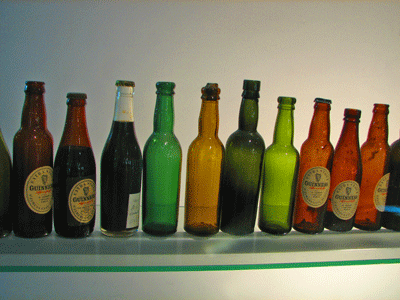
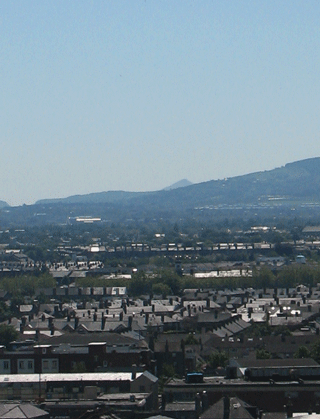
Our last day and once again we started with the now famous Ballyknocken breakfast. We were a little earlier starting as we planned to spend the time we had in Dublin. Once we got within the city boundaries we realized it was the day of the Dublin Ladies half marathon and that roads were gradually being closed off. We managed to get within seeing distance of the Guinness factory before asking direction, and then we were quickly there. Some women directed round the corner to the safe parking – all the luggage was in the car, and we were soon paying to enter the Storehouse ‘experience’. The self guided tour takes you wandering up to the seventh floor bar with panoramic views of the city, around a central atrium in the shape of a Guinness glass. We were taken through the whole process of brewing that rich dark pint and eventually reached the pinnacle where you could exchange your ticket for a pint. Lots of people were there supping away and admiring the view on the hot sunny lunchtime. But we couldn’t linger too long as we wanted to see the Book of Kells at Trinity College Library. We moved to a car park in town, and rushed off to Trinity College. On the way we saw lots of people dressed up to run in the half marathon – athletic outfits and silly costumes! Then we were in the courtyard with its Victorian campanile and hurrying towards the Library. It was very hushed inside and we walked through the first part of the exhibition, which explained the origins of the Book of Kells. It is very interesting and included many large reproductions of various manuscripts leading up to the book of Kells. The Book itself is displayed upstairs in a room of its own, lying open at one page. It would be wonderful to be able to turn the pages and view all the amazing calligraphy and illuminated pages. After seeing this, we had to ascend to the Long Gallery, which dates from 1732. At 64m long and with its spectacular vaulted ceiling, it is said to house 200,000 antiquarian books that can be borrowed by members of the Library.
Now we had to get to the airport as flights were calling us home. We managed the one way system and were soon handing over our car and catching the shuttle to T1. Check-in procedures were completed and we said goodbye as M & N and D & S went off for their flights; ours was a little later. It was a wonderful weekend and we all said a big thank you to S for her great generosity and organisation.


Sunday, May 31, 2009

Wicklow Weekend, Sunday

Today is D’s birthday, and after breakfast we planned the grand present opening – not that there were huge amounts of parcels as everything had to fit in the suitcases. We sat in the sunshine by the front door of the house, accompanied by the chooks who had generously donated their eggs for breakfast and various other delights. The sun was hot and there was a definite festive mood about. The paper was carefully removed and the gifts revealed - all to D’s satisfaction and surprise. So it was time to get going as we planned to walk from Bray to Greystones along the cliff top walk.
Parking in Bray was not easy and we finally drove into the car park of the last hotel along the seafront where they had spaces and charged three euros for the day. Across the road on the beach we found plenty of stones and virtually no sand – just a little at low tide. M and I looked in vain for sea glass, well we did find just a couple of bits and some worn plastic! We caught up with the others and began our ascent up the cliff. The path is quite wide to start with and then divides as paths go down to the shore and up to the top of the hill which has a big cross at the summit. It was a bit worrying that there was a sign declaring the path closed due to a landslip, but as lots of folk were coming towards us, we decided to ignore it!
Now the path narrowed and wound its way along the cliff just above the railway line that kept disappearing into tunnels underneath us. Below us we could look down to the sea and stony outcrops where sea birds were nesting. We think we saw cormorants, guillimots, fulmars, kittiwakes, razorbills and various gulls. The birds were nesting and must have had young as the gulls circled about harassing the parents on their way in to the nests. There were many wildflowers blooming along the path, too. This is a popular path and we had to let people pass as we stood aside in some places. We also stopped quite a lot to take in the view and all the activity out to sea.
After a couple of hours we could see Greystones and were soon descending towards the town. They are in the middle of a huge scheme to renovate the harbour area. It also looks like they are trying to halt erosion of the coast line. This all means a detour around the yard, which is full of enormous concrete blocks, yet to be lifted into place as part of the sea wall. When finished, many sea associated clubs will have access to the coast without fear of being washed away. Walking along the road we soon came to the other end of the town where there is a busy beach thronged with visitors on this lovely day. We indulged in ‘99s’ sitting on the wall before strolling to the train station to catch the Dart back to Bray. The train followed the track we had been walking over, dodging in and out of tunnels, but also giving us some fine views across the Irish Sea.


We arrived in Bray and walked down to the beach for a wander along. M and I made patterns from stones – it would be a great place for making interesting installations if you had the time, there are so many different kinds of pebbles. Others collapsed on the lumpy surface for a while – can’t imagine it was that comfortable! But it was time for a cup of something, so we walked back to the road and eventually came across a cafĂ© serving coffee and cookies. This was just perfect and we timed it right to take over a space from another family, just leaving. We watched people going by with chips and pizzas, but we were abstaining as we had dinner to look forward to.
Back at Ballyknocken we showered and changed and met downstairs at 19.30. The guesthouse doesn’t serve dinner on Sundays, but Catherine had arranged for us to go to a restaurant nearby. We drove down the road to the picturesque village of Rathdrum, found a parking space and then found Bates, our restaurant for the evening. It serves Italian cuisine and is situated in an inn (Bates Inn) dating from 1785. We had a wonderful meal: Scallops, sardines, crab ravioli; Wexford beef fillet, Wexford lamb, Dover sole, Sea bass, Silverhill duck; crème caramel with orange sorbet, chocolate fondant with ice cream, and tirimisu. We drank two bottles of wine: Principe Corsini Maremma Toscana Birillo Red Blend 2006, a blend of Cabernet and Merlot; and Gavi di Gavi 2008. Both were delicious. It was a perfect way to celebrate D’s birthday.


Saturday, May 30, 2009

Wicklow Weekend, Saturday

We met for breakfast on Saturday morning – a feast of home made delights and mostly local produce. After Ballyknocken cereals we had French toast or drop scones with nuts and syrup or a full Irish breakfast for one brave lad.
Our first day was spent around the Military Road, starting with Glendalough. On the way there we passed through the highest village in Ireland, Roundwood (238m), which seemed quite popular with the tourists. We found a space in the busy car park at the Glendalough information centre and then followed the path to the old monastic settlement. Founded by St Kevin in 6th century, this is an important site set at the head of a valley containing two lakes. It was sacked by Vikings many times, and then partially razed by the English in the late fourteenth century before falling victim to the Dissolution, 1539. Even so, pilgrims still visit the site especially on 3rd June which is St. Kevin’s Day. Some restoration took place in the mid eighteenth century, but most of the buildings date from between the eighth and twelfth centuries. We walked around the area and then followed the river down to the first or lower lake and back as we had to be on the move again.


 Now we followed the road back and on towards Powerscourt House with its magnificent gardens. The house was a Palladian mansion of considerable size dating from the early eighteenth century and built on the site of a Norman castle. Sadly it was gutted by fire in 1974 but has been partially restored to provide cafes and shops for visitors as well as an exhibition about the history of Powerscourt estate. Luckily the gardens remained intact and are beautifully kept.


We wandered through all the areas, including the Japanese Garden, around the Triton Lake, Dolphin Pond and the wonderful walled garden. There are lots of statues in the Italian style (e.g. after Bernini) which reminded some of Angels and Demons! From the terrace there is a good view of Great Sugar Loaf (501m), made from Cambrian quartzite, it forms a volcanic like cone above the surrounding hills, which are Devonian granite. We decided to have a little late lunch in the café before moving on to the highest waterfall in Ireland. Powerscourt Waterfall falls 130m, and we think that is the height referred to, but it could be the highest in elevation, too.


Reading the guide book, we understood that this was an idyllic area to visit where Sika deer may be glimpsed among the trees and bird spotting was a delight. We were not prepared for the sight that met us – a valley full of cars, picnickers and barbecue aromas wafting across to us. It was awash with people, all enjoying the lovely weather and the beautiful area. The waterfall is lovely as it cascades over the rocks, and many people were enjoying a dip in the pool at its base – albeit a bit cool as it was in the shadow of the rocks. Needless to say, the Sika deer were long gone and only a few sparrows and starlings were to be seen.
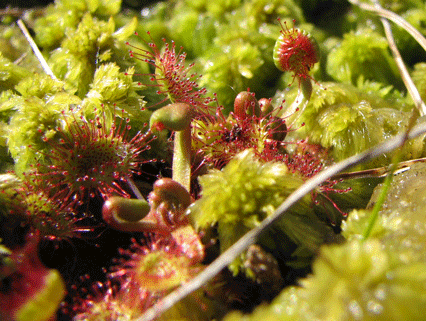
We had also read that there were sundews to be found around a place called Sally Gap, so this was our next stop on our circuit of the Military Road. The roads are fairly narrow and winding, so we had to find a pull in so we could search for them. We stopped to look at some deer some way from the road and M went off on a reccy. And there in a boggy area she found loads of sundews, which we all saw and photographed. And even though we stopped another couple of times, we just didn’t find that many again. That was a good and lucky find. So we had to get back and change for dinner at seven. This was at Ballyknocken House – from the kitchen of Catherine Fulvia, so we needed to be ready to do that justice.
At seven we were served dry sherry in the sitting room. There were several other people staying at the house including a Belgian family, some Americans and a couple who were attending the cookery course on Sunday. The wife came from Milan, so was very interested in Catherine’s style of Italian cookery. We went through for dinner after Catherine came and described the meal. We started with antipasto, followed by a potato and lemongrass soup with parsley oil, which was served with Mary’s Brown Bread. Then came sage stuffed pork with carrot and cumin puree and apple slices and a dessert of pear and polenta cake with a strawberry stack. With the meal we drank a wine from the Ardeche estate Mas de Libian, Bout d’Zan. Coffee and tea were then served in one of the other rooms, and we gathered round a table with a hilarious game of naming things beginning with a letter chosen with the roll of a die, which ended in hysterical laughter! It was time for bed.