Monday, May 31, 2010

Surrey County Show

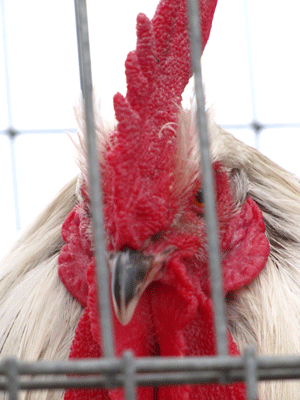
Surrey County Show was on 31st May this year. A cool but dry day when some 40,000 visitors descended on the Stoke Park Showground and had lots of fun. 


These images are mostly animals, but there was plenty of other attractions such as all the stalls selling food, clothes, equipment of all kinds, a farmers' market, displays by various organisations and some tremendous fun in the several rings that were surrounded by onlookers most of the day.
Next year's show will be on Monday 30th May and you can find more here.

Sunday, May 23, 2010

Lycian Way


An early breakfast and soon Hasan was ferrying us across to Ucagiz to meet Dennis (Deniz) from Middle Earth travel who would drive us to Antalya airport. Dennis came tearing in somewhat late, but cheery and ready to whisk us away. We thanked Hasan, as we had thanked his wife, for their great hospitality, and were soon on our way.
Densis was great, pointing out landmarks on the way and stopping for photos when there was a tomb not too distant. Then we were sweeping along the road to Antalya, passing towns, a lagoon and resorts all along the coast. As it was Sunday the roads were quiet and we made amazing time, arriving in good time for our flight to Istanbul. Dennis made very quick farewells as he was off to catch up on some sleep before doing it all again in the evening! We checked in and then sat down for a coffee and some wonderful Turkish pumpkin dessert called Kabak Tatlisi. Then it was just travelling until we got back home just after midnight.It has been a really wonderful holiday and we hope for more visits to Turkey in future.
Middle Earth Travel, Dennis's company.

Saturday, May 22, 2010

Lycian Way

It rained in the early morning and the air felt fresh when we climbed down the steep steps to breakfast in the cafe. There were tiny frogs on the steps brought out by the weather. Breakfast was standard feta, toms and cucs with olives and bread, and Ahmet, Hasan's brother brought us boiled eggs. There was honey and strawberry jam and cups of Turkish tea. We asked about a trip on a glass bottom boat and in no time at all he had arranged for a boat to come and pick us up from their quay and take us across to see the ruined port of Kekova under the water. We came up to the room for cameras and jackets and then we went down to the cafe to wait for the boat. It was quite busy out on the water with boats arriving at the various quays ready for the apparent bus loads of tourists that come. While we waited a scarce swallowtail butterfly (that's actually its name) came by to sup off the flowers in the window boxes along the terrace.
Then our boat was arriving and we climbed down to the quayside to climb aboard and meet our captain, Verhat. He took us away across to the island and along the shoreline with the hatchway of the glass window open, so we could see the remains of houses and fragments of amphori lying beneath the surface as they had gradually slipped into the sea. The island, Kekova, is sinking 15cms every 100 years. It seems to be something to do with the continental shelves that come together in the Mediterranian Sea. We could see buildings that were partially submerged, steps rising out of the sea, even a hammam just under the surface. Apparently their were some hundred houses making up the city - so around five hundred people. We chugged along past the end of the city and headed for a beautiful inlet called Tersane. Here we found one rather large ocean-going catamaran moored, but Verhat manouvered our little boat in reverse so that we could step ashore via the rear gangplank. At the head of the cove is the ruin of a Byzantine church. We could clearly see the walls and partial remains of the cupola, but Verhat says it is gradually falling down from the wind and rain. We walked over to the ruin and then up the hill at the back which took us to the other side - a rocky shore but also with several ruined houses up both sides of the little pass. As we turned to come back we noticed something approaching - a flotilla of canoes. They soon arrived with their support vessel and were coming ashore before we got back to our boat. Many rowers were then donning snorkels and slipping into the water for a little underwater sightseeing. Verhat served us Turkish tea and biscuits and oranges back on board and we were amazed to see our peaceful cove completely filled with over fifty canoes, three of four small support vessels and at least four large gulets surrounding the catamaran. It was time to leave!


Verhat sneaked his way through the boats and snorkellers and we soon were out into the mid channel heading back to Kalekoy (Castle village) or Simena. The clouds had blown in again and the hills looked misty with rain, but it was very light on the covered boat, although we did put on our waterproofs as it was a bit cool. Just before we got back, Verhat pulled the boat across the bay so we could see the sunken sarcophagus that is pictured on the postcards. Then we were back at the quayside and the rain began bucketing down and the thunder rolled.
After a while the rain stopped and we read on the kush in the courtyard. Then we decide it was time for a walk and we went out by the courtyard gate and wound our way along the pathways between the houses, gradually making our way down to the shore. We came across several tortoises, even one small one who was voraciously munching new leaves of a climbing vine, maybe of the morning glory, of which we saw lots drooping over the walls. There was also some bouganvillia, some pelargoniums and ? Lantana. As we walked further along we came to a view of the sarcophagus in the water. Then we walked back a little way and up and up to eventually come out just under the castle with great views across the water. We soon found our way back to the room and the cat was there with her kittens, again. We decided to go down to the cafe for some homemade icecream. The Ks had arrived, and had sheltered in the deserted polytunnels when it rained, but were OK and enjoyed their walk. They went off for a swim and we read a while, then came back to pack and shower and dinner is at 8pm.


We met the Ks for dinner and started with a mixture of mezze one of which seemed to be samphire and also rice, dolmas and pepers in yoghurt. Then Alan and I had chicken which came with rice and peppers. We also had salad on the table. To finish Hassan's wife brought us what may have been halva - a sort of slightly sweet sesame tasting paste; and then we had turkish tea and talked a lot.
And that was the end of the holiday, we leave at 8-ish in the morning by boat to Ukagiz where Dennis (Deniz) will collect us and drive us to Antalya airport; then to Istanbul and the flight to Heathrow.

Ankh Cafe and Pansyon

Friday, May 21, 2010

Lycian Way

We had breakfast with the Ks at nine as the walk would be a bit shorter today. During breakfast Canan downloaded my photos, then asked us about the 'black currants' she has been colecting yesterday. She had looked them up on the web, but now knew they weren't black currants. So we all went to have a look at the bush was growing out of a limestone rock and had small broadleaves and tiny pale reddish berries, which would ripen into the black ones. The flowers had been white. It looked rather like a cotoneaster, but we weren't sure. I have a sprig to take to Wisley to ask the experts.

By 10.30 we were walking to the east gate with Canan having bid goodbye to Suleyman and we thanked them both for our very fine stay. It should be downhill all the way. At first we followed a red spot trail plunging down the hillside quite quickly and we seem to reach the distant polytunnels in no time maybe just over an hour. We negotiated our way past the village dogs of Kapakli and successfully found the first red and white markers indicating that we were back on the Lykian way. Less than halfway to our destination we pressed on through the rocky landscape up and down various gullies but seldom flat, reaching the coast at a pretty bay, then climbing up above and down the other side passing by a collection of derelict buildings. There was a yacht moored in the bay. We followed the coastline as it dipped in and out forming coves all along, and we passed a large banner pinned to the rocks advertising Smugglers Cove for a good evening's entertaiment with free water taxi all night! It was getting on, and we needed to have our lunch somewhere, so we found some suitable rocks with a pleasant view and sampled Canan's picnic.
Another hour's walking with very painful toes brought us to the graveyard and we turned left off the track to take the footpath over the hill by the Crusader Castle and the Lykian Necropolis. Suddenly we were in Simena and down a few steps past the market stalls we found our turn to Ankh Cafe and Pansyon. Hasan, the owner was planting climbing morning glories in an improvised flower bed by the door to our room.


He let us in to a great big room with the door onto the street and one into a partially covered courtyard complete with Turkish kush. No time to waste, and the shoes were taken off immediately and feet up with a cool bottle of water. We opened the door to the courtyard, but kept the screen closed, and about 4.30 Pat came knocking at the door. They had been lunching in the next door village on octopus and chips. She showed us the courtyard cat that had recently had three pretty kittens. We arranged to meet at around 8 for dinner.
A and I went down the steps to the cafe and had coffee and read for a while before coming back up to shower and change. We returned to the restaurant part of the cafe (inside) and ordered Raki. They serve doubles with lots of water, thank goodness, as it's quite strong, but deliciously aniseedy. P & R arrived and we sat together for dinner. It began with a buffet of mezze and while helping oneself, you ordered your main course from a selection of chicken, fish or prawns. Hassan's wife then cooked it freshly for you and served it with salad and bread. A and I had beers with our prawns. There was a plateful of fresh fruit for dessert. Pat had some Turkish coffee while we chattered about this and that, but we were really tired and they had to be at breakfast at 7.30am as we will be the next day to get to the flight for Istanbul, so we were soon climbing up the stone steps to our rooms.

Thursday, May 20, 2010

Lycian Way

Today was a rest day, so we really took it easy, not having breakfast until 9am. We thought the others would be long gone by the time we arrived, but they were also lingering over breakfast. Canan brought us cereal and milk and then a square china platter filled with tiny bowls of all sorts of preserves, olives and some butter. Canan makes preserves out of all sorts of unusual fruits, for example, watermelon, sandalwood berries, myrtles, peaches, orange peel as well as several others. There was also some freshly squeezed OJ; a plate of beautifully arranged cheese, figs and apricots with raisins and walnuts in the middle; bread, and tea and coffee. Canan also asked us how we wanted our eggs, but we declined. There was plenty to eat already.

We lingered over our meal, second cups of tea and coffee, as the others were preparing to leave or so we thought, but C and M went round the pool and sat on the swing seat , and P & R engaged with Suleyman. We decided to take a stroll along the path round the estate,and met Canan who pointed out the honeymoon house, their new house and some more of the guest accomodation - some rooms like our and some suites with a sitting room. There is also an artist's cottage, which has a kitchen so that the artist/writer/composer can come and stay for a while and cater for themselves if they wish. We followed the path round past their house, and met up with Suleyman who was taking P & R to the cottage, and he invited us along. It is a lovely place with a roof terrace overlooking the bay at Demre. The spiral staircase has no hand rail, so extra care would be needed if you went up there for sundowners!


We pottered on around the garden finding terraces of marjoram, thyme and also the sage from which we had tea last night. There were some beautiful insects flying around us, and the noise of the bees made us think of Yeats' poem The Lake Isle of Innisfree and the 'bee loud glade'. Eventually we arrived back at the terrace and Canan showed us that there was a socket, so I could sit and write up this journal, so we stationed ourselves there and she brought us some coffee. P & R seemed to have left and then C & M also went out, leaving us on our own. As we sat there we saw Suleyman showing some people around, one with a clip board. Later we discovered that this was the man from Lonely Planet. I hope they give them a good write up. We declined lunch as we had eaten so much so far, and at 2pm we decided it was time to go walking around the ruins of an ancient Lycian city on the hillside above the hotel.

We discovered all sorts of tombs, both free standing sarcophagi and some carved in to the rock wall itself. We scrambled all over, going up and up to the acropolis at the summit with spectacular views down to Simena where we walk to tomorrow. Although we got a little of the normal track, we were able to find a way through the undergrowth and around, eventually ending back on more level ground again after a couple of hours or so. As we walked down the road to the hotel we spotted an owl on a tree in a courtyard of one of the houses. It had caused quite a commotion amongst some of the other birds. We thought it was probably a Little Owl. Back at the hotel we read on our terrace for a while, but with the breeze and sitting in the shade it got a bit too cool, so we moved over to the poolside, and C & M had come back and were also there. And Canan served us tea and sesame topped cake in the late afternoon sun. Dozing over our books, suddenly we were roused by Kevin. They had just arrived with Ismet, after their walk from Adrasan. They were duly impressed with this place and we met again over dinner with C & M, too.

Everyone had had a lovely day and we had a delicious meal: Minestrone type soup, salad with aubergine salad and stuffed green and red peppers, a sort of sausage roll - pastry stuffed with a savoury mince, and a blancmange with chocolate ice cream. Plenty of chatter and really pleasant evening. Now we are in our room listening to the owl hooting in the background. It will be hard to leave this wonderful spot tomorrow when we move down to Simena.


In the stones around the house we also saw quite a lot of fossils ,which we have discovered to be nummulites. In fact Suleyman has used the shape in the sign for Hoyran Wedre, incorporating it as the 'O'. These were ancient sea creatures (marine protozoa) and these are their fossilised shells from between 65 and 25 million years ago.The name nummulite comes from the Latin word for coin as that is their shape. (Google 'nummulite' for more information.)

Hoyran Wedre information
About the Lycian ruined city

Lake Isle of Innisfree by W B Yeats
I will arise and go now, and go to Innisfree,
And a small cabin build there, of clay and wattles made;
Nine bean rows will I have there, a hive for the honey bee,
And live alone in the bee-loud glade.

And I shall have some peace there, for peace comes dropping slow,
Dropping from the veils of the morning to where the cricket sings;
There midnight's all a glimmer, and noon a purple glow,
And evening full of the linnet's wings.

I will arise and go now, for always night and day
I hear lake water lapping with low sounds by the shore;
While I stand on the roadway, or on the pavements gray,
I hear it in the deep heart's core

Wednesday, May 19, 2010

Lycian Way

We slept like logs and felt well rested to start the next section of the walk. Fezule served us breakfast on the upper outside terrace - a platter of cheese, tomato, cucumber, olives, egg and a slice of melon, served with some of the Turkish white bread. He also brought us mugs of tea. When we went down to pay for our beers the night before and to hand over the voucher, Carol was there with our picnics, which included some cake she had made this morning. She was up early taking the young people to Kas, so that Ronnie ( her assistant) could renew her visa by making the short journey to a Greek Island and returning with a new three month visa - like we had bought entering Turkey at Istanbul airport. Now all ready for the off, we noted which car Ismet would be using to collect us at the end of the walk at Melanippe beach, and set off.
Our road took us gradually up to an old deserted camel farm and then the real climb started through the forest. The route twisted and turned relentlessly upwards with some level parts, as the track followed the contours of the hill. As we climbed we had glimpsed views of the sea way below, turquoise and dark blue against the rugged cliffs. Once again we felt as if we were the only people on the trail, until we saw a couple of people ahead. We gradually caught up with them and it turned into a whole group of Brits walking together. There was one poor chap complaining of a nasty bite he had on his hand - either an ant or a scorpion, which was making his walk very difficult. They were having a group photo against the backdrop of a rugged headland and an island and the blue, blue sea.
We walked ahead of them, continuing along the coastline and through the forest. As the track turned inland it started to climb and on and upwards we went coming to a steep climb up a rock wall. It was a tough climb and we were thankful when we were in the shade of the trees and when there was a little breeze to cool us. As we reached the top we could see the sea on both sides, with a view of the island that had looked just like a cone from the first time we had seen it, but was now a long rugged shape. (Sula Ada).
Just down from this summit we found a shady spot and sat down to enjoy Carol's picnic. We had bread and a chicken drumstick with tomato, cucumber, matchsticks of cheese and carrot(?), but we saved the sweet things for afternoon tea at the beach. So we set off again, clambering down the hillside, soon spotting the lighthouse below us. It took a short time to reach it, now an automatic station with its living space abandoned. We turned right along the coast and followed the easliy seen trail through the forest to a dirt road. Here we had another surprise as we had to follow this road up over another ridge to get round another headland - a couple of kms and down to the turning for Melanippe. We eventually reached the beach at 4.15 to find picnic tables and a stony beach and some cool shade where we could partake of our afternoon tea - apples and fairy cakes that Carol had made. At 5pm Ismet arrived with Carol and we were glad to throw the bags in the back of the Ford Connect and relax as they drove us to the ATM in Finike. A got some cash out ot the wall, then spotted that the little shop by us was selling Magnums, so he treated us all. Ismet was very pleased as he loves chocolate - and Carol also as it was her first of the season!


On we then drove, seeing some crazy driving that even Ismet remarked on as tires squealed and we all thought one of the cars would surely leave the road. But Ismet drove us safely to our destination, Hoyran Wedre Country House Hotel. Here we were greeted by Suleyman and all four of us were served tea and delicious sweet pastries, before Carol and Ismet left as they had to drive the hour and a half back to Adrasan. Suleyman showed us to our room and dinner would be in half an hour at 19.30, so we quickly showered, changed and came back to the terrace to find Pat and Robin and another couple, Carol and Marcus, ready for dinner. As we were all together on one table, I did not make any pictures of our food. This was prepared by Canan, wife of Suleyman, and began with lentil soup, then we had a ratatouille with peppers and also one with courgette and a Turkish salad, which was followed by kofte and rice. Suleyman recommended we should try some Lykian wine - a Merlot Shiraz, which was lovely. We chattered away through out the meal and soon Canan was offering us some special sage tea. This was not from the normal sage leaves we have and that grow in abundance all along the trail, but one with long curling flowers, giving the infusion a gentle soothing flavour. As we were tired from the walk, we were soon ready to retire - as was everyone else, so off we went and were soon soundly asleep in our comfortable beds.


Hoyran Wedre information

Tuesday, May 18, 2010

Lycian Way

We got up having hardly slept. To start with a mossy was flying around our heads and buzzing in our ears. We had left the windows open and the curtains, too as the a/c had no remote control. Then just as we were dropping off the muezzin started followed by the the cocks crowing!
We were almost on our own for breakfast and there were filo pastry cigarellos filled with spinach and cheese as well as fresh OJ cheese, tomatoes, cucumber and bread and jam. One of the boys brought us fried eggs as well. Then the other two arrived as we were about to leave. A went to pay our host who charged an astronomical amount for the wine - two teas and our wine was TL65. We collected our picnic - half a loaf each split in two with some cheese triangles plonked inside, a tomato and a whole baby cucumber. This was in a large polystyrene box far too big for our rucksacks as there was also a pomello each. We unpacked the boxes and just used the polybags, managing to get those into our bags. Then we set off for Olympos, quite glad to leave this pansyon behind.
We walked down to the beach road and paid our entrance fee to the ruins, then crossed the river at the far stepping stones to the south necropolis. Immediately we started climbing up from the river and were quickly looking down on the ruins. The path then followed the hillside round crosssing a dry river bed several times and climbing up and up. We were glad of the breeze as it was hot work and it took us about 3hrs 15 minutes to the summit where we were met by a stiff wind. Just before we got to the top we met a young Aussie lad who was coming down who had warned us that it was pretty windy on the top and that we should find some shelter by an old hut if we could. We had also met some others on the way, notably some singing Italians, who were so busy with their song and with hurtling down the path, that when they came to us - we stood to the side to let them by - they were completely surprised to see us . They hadn't noticed us at all.


So as we got to the summit we saw the ruins of the old pirate hideaway city. These pirates were partly to blame for the demise of Olympos as the Romans laid waste to Olympos in order to capture them. It was never the same again. We also passed a Dutch couple who were very cheery, then we found the path to the hut, which was completely taken over by the French walking club, but there were also plenty of rocks to sit against to shelter from the gale! We had about half of our picnic and one of the pomellos, then decided to get on our way, so as not to get too cold. There was another British couple walking down at about the same time as we started off again and then the French group came, too, and we all mingled together as they passed us with a cheery ' Bonjour!'. They were just ahead of us most of the way down. The last section of the trail was quite difficult and we missed a vital turning off the track where someone had bulldozed a new road through, obliterating the signs. We should have turned off the track at some point, but ended up in the greenhouses and walked down to a main road (still a dirt track, really) and followed the river down into Adrasan. All the while the wind was blowing and as we walked first past all the pansyons along the river and then along the sea front, we were sand blasted with the dust being blown about in the wind. It seemed a long trek to our pansyon, but we eventually arrived and Fezule welcomed us with a cup of tea on the upstairs terrace of Maviay and the wind blew. We also met Carol who with her husband Ismet owns the place. She said that they had had to retreat indoors as the stormy wind was so bad. Fezule took us to our room and we were glad of a rest and showers before dinner at 7.30. We realized that there was no power and A went across to ask if we hadn't switched something on, only to find that indeed there was a power failure due to a cable coming down in the wind. Our room was plain and cheerful with its ensuite and small balcony
We went across to the main building for dinner inside and as darkness fell we had dinner by candlelight. Carol remarked that it was very quiet as with no electricity there was no music, so we chatted. The brother of a British girl who worked there had also arrived with his girlfriend. They were interrailing around Europe and had got as far as Istanbul on the train, then had made a 14hr bus journey before Carol had picked them up in the nearest big town. We had a delicious dinner if a sort of bisque soup followed by sizzling chicken with mushrooms and veggies with a cheesy topping and lots of salad. Then we had some sliced fresh fruit and a cup of tea. We retired quite early as we were so tired after the walk and the sleepless night before. We were reckoning up the distance and felt that adding up the signs and the distances in the book, we must have walked over 20kms.

Maviay Hotel

Monday, May 17, 2010

Lycian Way

We had breakfast a little later this morning. The muezzin had gone off at around 4.30am, so we had been awake in the early hours. There were breads like piroshki at breakfast as well as toast, eggs, savoury bits and pieces, and lots of homemade jam. Turkish tea was aslo available and freshly squeezed OJ. We watched Pat and Robin march off on the next long trek; we will see them again in a couple of days time. After looking at the photos on the TV, we also set off to the ruins of Olympos down the beach. A lot of dark looking cloud hung over the mountains, obscuring the peaks, but it was quite pleasant walking with the sea breeze. We walked along the road parallel with the beach as far as possible, then swung round onto the beach road and the beach, which was fairly soft and not easy to walk along. We crossed a small stream and as we approached a second stream we could see the start of ruins up in the rock face. We turned right up by the stream and paid our entrance fee of TL3 at the kiosk. Anyone coming to the beach from this end must pay to walk through the ruins. These are extensive and we spent a good hour and a half wandering up side tracks looking at collapsed sarcophagi, roman villas and whatever all overgrown with centuries of neglect. As we walked up the main path by the river we saw some sort of heron/bittern fly into the bushes upstream. This seems to have been a little bittern. It was very interesting, but by now we had reached the point where we needed to cross the stream to look further. We decided to get a drink before we did this and there were two small cafes with lounging tables where we could get a glass of freshly squezed OJ, sitting on our elevated platform with our legs up under the table. This is a Turkish Kush, and very jolly. One could easily fall asleep lolling against the cushions with your legs horizontal. There was the cook making Turkish pancakes just to the side of us, all very interesting. It was very soporific in the shade of the trees, but we had to move on so as not to fall asleep, and we paid and made our way down to the stepping stones. This is where we will cross tomorrow at the start of the long trek. There were a couple of white egrets pecking about on the other shore that soon flew off as we approached. We splashed across and up the far bank, tuning left, away from the Lycian Way path. Along this side of the stream we found more mausolea, the theatre, the hammam and the harbour walls (looking like Inca walls, all stone blocks, fitted together eccentrically without mortar.) It was very interesting and it must have been amazing at its heyday with arched walkways along the quayside, villas etc. and a prosperous port. All this seemed to have been ended by earthquakes, which are not infrequent.


We now crossed the stream again by another set of stepping stones and strolled back to the beach. There was a sort of pirate boat anchored off shore, which we discovered was for some Russians that had been visiting the ruins. The boat was a gulet, a wide-beamed traditional boat that can be hired for 'blue cruises' of about four days to explore the coast.
It was hot strolling along the beach, so we eventually took shelter in a shady cafe serving gozleme, or turkish pancakes. We ordered chocolate filled ones with homemade lemonade - rather like the fresh lime we used to have in Oman. It came with sprigs of mint and a slice of lemon and was so refreshing. After Alan had a cappuccino and I had a turkish coffee which is very tasty, but very small and very thick at the bottom. I was glad of the water that came with it - surely not from a bottle! Further walking along the beach we spotted what we think was a masked shrike on the telegraph wires, but he was soon gone. Then the road back to the hotel for a quiet hour or two before dinner.


Near the start we also saw a crested lark (in a cafe!) and a big lizard.
Tonight we met the other walkers, K&K, who only took 6hrs to do the walk! For dinner we had leek and cucumber soup with dill, turkish salad with stuffed peppers and something, then grilled dorada. All very tasty with our left over wine.


Olympos on Wikipedia

Sunday, May 16, 2010

Lycian Way

We were up and packed for breakfast at 8.30 in hope of starting by nine, but when everything was done it was nearer 9.30 when we started. Hakan gave us a god's eye for luck (nazar boncugu), then as they waved us goodbye, Mehmet threw a pan of water on our path to wish us a clear and flowing journey. And this was how we started the Lycian Way. We walked through some lovely countryside with spectacular views across valleys to mountains with clouds hanging between them. There was plenty other things to see as well with the wildflowers and some amazing insects, tortoises and a few birds. There were beetles of various kinds including a shield beetle, 'long horn' beetles, red ones etc. Alan spotted a praying mantis - just a small one and we also saw lots of butterflies and a couple of dragon flies and some blue and some white damsel flies. There were also skinks and a couple of frogs in a pond. He even saw a snake that fled off into the undergrowth at high speed. Our first stop was by a gate, which we reached just 10 mins over schedule, so we were quite pleased. The track went over the gate and we bashed on following the red and white waymarkers, but at times they were a bit obscure. Nevertheless, we did well and came down to the main road only half an hour over time. We crossed and took the small road off to the right which swung round and down onto a wide track where we met a Turkish couple who pointed us in the right direction, and then another man who told us that the turn we were looking for was just ahead. We found it and then wandered downwards passed a house where a woman indicated that we should cut across to the right. It was tricky to see the correct path through this overgrown field, but we managed and eventually came down a narrow path on to another small tar road. On the chimney of the small house at the junction we spotted a couple of largish lizards that were living there. Turning right, we followed this road passed some rather posh restaurants - one where the guests were lying on couches on wooden platforms in the river, reached by little bridges. We walked on by and after a few minutes saw the sign to the recommended eatery. It was advertised next to another restaurant advertising in Russian! When we got to Havuzbas(h)i Restaurant, they were very welcoming and took us up to a platform over the fish tanks with a great view down the valley. They served us flatbread, salad of onions, tomato, cucumber, herbs and carrots in a balsamic dressing, yogurt, cheese, aubergine, cheese stuffed mushrooms and one trout divided between two, A had a beer and I an oj. It all came to about £11 - very good value.

It appeared that the afternoon walk was a bit shorter than this morning as we had already done 10Km, so off we set feeling quite pleased. Just behind the restaurant our track took us under some trees - mulberry and fig, with lots of fruit on them. Our first obstacle was the Ulipinar River. We clambered down to the bank, meeting some other walkers who just remarked that it was shoes off time! And so it was, but we crossed only getting our rolled up trousers a little wet. It was very refreshingly cold on our feet and legs. Shoes on again, we resumed the walk to the sound of water and began to climb above the river. There were oleanders in the river bed, reminding us of wadis in Oman. The diagonal climb across the hillside went on and on and we found it very tiring. Frequent stops, then 'pole, pole' owards and upwards brought us eventually over the saddle to views down the valley to the beach. On the climb, Alan had disturbed a family of chukars on the path - mum and chicks who scurried away - leaving a couple of slowcoaches that he chivvied on into cover, so they didn't loose the rest of the family. Just down from our stopping point we spotted the upper eternal flames of the Chimaera - quite a surprise. We walked down to them and took photos. As this was here, we thought it wasn't far to the next flames, but we hadn't reckoned with a difficult descent off a ridge down into the gully, which took us a long time. We eventually arrived at the Chimaera large flames, which are amazing. We stopped to take some pics, and also saw the ruined byzantine church before leaving down the path to the bottom. Again, underestimating how far this was, we descended about a Km of deep steps built for giants, but came to the bottom where we needed to pay the man 3.50TL each for seeing the Chimaera. As we left, just 20m from the place a Brit cycled by and asked us how far it was. It turned out he came from Kingston! Said it was very quiet in Cerali. On we bashed - another 2 Km to go to the pansyon. We saw lots of bee eaters on the telegraph wires - beautiful colours, plod plod plod, then we saw the landmark mosque with our turning just 25 m along and the Anatolya Resort just down on the left. It is a lovely place with lots of peacocks - even a white one. We were spotted by P&R from a couple of nights ago, who pointed us to the entrance and we were met by a pleasant young chap who brought us some tea. Dinner was at eight, so we washed and showered and looked at the view of Mt Olympos, watched the birds swooping around, then into dinner of pea and mint soup, mixed salad with tsatziki, ratatouille with chicken and choccy pud. Didn't manage to take pics of it all, but enjoyed a glass of red Angora with it. Afterwards we compared notes with the other two, who had also found the days walk a bit tough. They have another tough walk tomorrow when we get a 'rest' day and then it's our turn again.


About Nazar Boncugu, the Turkish evil eye

Saturday, May 15, 2010

Lycian Way

Breakfast was at 8.30 and we found the other couple (P&R) already seated on the veranda. They are doing the same trip as us, only one day ahead. They are off on the first of the long walks today, then we catch up with them tomorrow. We helped ourselves to juice, bread with savouries or preserves, yoghurt and fruit. We declined the eggs.
The chef made us a picnic - would we like cheese, salami, mixed - so we went for mixed. And we collected a paper bag each before we set off on our walk to find the ruins of the ancient city of Laodikeia.
It started off quite hazy, which meant it wasn't so hot and around the Lodge there seems to be pleasant cooling zephyr. We needed to follow the red and yellow stripes painted on the rocks, supplimented with some cairns along the way. Our first landmark was the shepherd's hut just below the lodge grounds, not too difficult, then we trekked up hill a bit and followed the contours round the hill. Mount Olympos towered over us to left. Apparently there is a restaurant on the top, which you can get to via a cable car. Looks a more likely route as it is a very craggy, spikey peak. The way was lined with familiar plants - lots of euphorbias, thistles, sage, minature leaved holly bushes, giant fir trees that may be casurinas and much more. At one point we found a euphorbia covered in small lime green and black caterpillars, then Alan noticed some gigantic caterpillars, again on euphorbia. They must have some special way of getting rid of the latex so they can eat them. We think they are the caterpillars of the Hawk moth, hyles euphorbiae robertsi. We also stopped and watched a treecreeper in one of the tall fir trees, busily working its way up the trunk.

The path was strewn with rocks for the unwary to stub against and it wound up and down, across small ravines and around the hillsides. The guide was very helpful, but from halfway along we began to have difficulty locating the red and yellow stripes, backtracking a couple of times and finding that mysteriously we were several metres above or below the next marker. There is a scree slope to cross with some fascinating rocks - like a mudstone with inclusions resembling cork bark and maybe trees and fruits - like nuts in shells. Perhaps we were just being a bit fanciful. Then, when we were sure we were on the wrong track we saw the sign to Laodokia about ten meteres above us, so we scrambled up the hill and found another track. This took us upwards and we soon had our first glimpse of the ruined city. There are few buildings left, but from those few you can see that this must have been a spectacular site, with views down the valley to the sea. There were windows made with the cut stones, using stones with a bevelled edge. Many walls have fallen, but there are some still partially standing, showing the careful building that has lasted nearly two millennia.
We found a group of flattish stones and sat down for our picnic - mixed rolls with cheese, salami,tomatoes and herbs all crammed in and tasting very good. We also had juice and an apple. It was lovely in the shade of the tall trees, as at 1pm the sun was out and it had become quite hot. In this place we seemed to be in the lee of one of the hills and no cooling breeze reached us.
The return trip was also challenging as many of the rock markings are visible from the outward journey, and sometimes obscured from the other side. Nevertheless we made good time. We stopped at one point to watch a skink, very pretty with greenish markings and a light green ubderbelly. Having spotted one, we soon saw quite a few dashing among the rocks.
We were back to the shepherd's hut quite suddenly and walked back up to the Lodge for a rest on the everso slightly breezy veranda. Lovely. So far no tortoises have been spotted despite the warning notice at the entrance to the Lodge.
Update:
After resting for a while we set off to hunt the tortoise, and found about half a dozen inthe scrub below the Lodge. Then,as we were walking back up to the room we spotted another one in the grounds in the middle of some purple flowers. Time for showers and a change before beer and monkey nuts on the verands before dinner.

Dinner was again fabulous, with the main being a mixed grill BBQ - lots of meat and very filling. There is another couple here tonight doing the same walks as us only a day behind (K&K). Inntravel seem to have it all well organised. When we told Hakan that we had seen the tortoises he told us that he used to have one that moved so fast they called him 'turbo'. Then Alan put some comments in the guest book before we retired.

Olympos Mountain Lodge

Friday, May 14, 2010

Lycian Way

We had to put the a/c on in the night as it got impossibly hot, then it blew really cold air on to us, so we snuggled under the duvet!
Today we had some time to ourselves, so we went for breakfast at 9am in the small restaurant in the basement. It is also covered with lamps like all the other ceilings. We had to check out before going off, so they put our bags in a cubby hole under the stairs.
We set off down to the coast, remembering the route from our last visit and soon found ourselves by the bustling ferry quay side. The Galata Bridge was down to the left and looked crowded with fishermen with their long poles and lines. We climbed up the steps onto the bridge and began walking across, peeking at the fishermen's catches in plastic containers and some oversized glass jars. They seemed to being doing very well for lunch. At the other side, we crossed under the bridge and found the small fish market in full swing. There were all sorts of fish, seafood and even swordfish on display. Now we had to climb up to the Galata Tower, the most prominent feature of this area. It was built in 528 AD by the Byzantines, was taken over by the Ottomans in the mid 15th century when they captured the city. Whereas the Byzantines had arrow slits in the 4th and 5th floors, the Ottomans put canon windows in on the 6th floor. It has been used as a watchtower and a firetower, but gradually fell into disuse. It was renovated and reopened in 1967. We paid 10TL to go up in the lift to the 7th floor, then walked up a couple of floors, taking in the restaurant and nightclub on the way. The balcony on the ninth floor runs all the way round, giving panoramic views of Istanbul. Photos taken and the circuit completed, we climbed down the stairs again to the lift and the ground floor. Now to find some coffee, so we headed up the street of musical instruments and round the old streets to find a suitable place. The first one we stopped at was a rather posh cafe with its own coffee, teas and olive oil, but we sat and sat and no-one came to serve us even though they had brought us menus. So we left and found another place where they were very friendly and soon had coffee and cake on the table in front of us. We had one portion of carrot cake served with orange preserve - not really marmalade, but cooked rind in a tasty syrup. That and the coffee were delicious.

Across from this cafe was the entrance to the funicular, described as one of the oldest underground systems in the world. The funicular runs up and down to the tower in an underground tunnel. It is in beautiful condition and we enjoyed our 1TL ride immensely. We came out a couple of streets above the fishmarket, and walked down the main road to the bridge. Walking back over we took the bottom tier, passing numerous restaurants and cafes all touting for business. At halfway you have to climb the stairs to walk across at top level, leaving the gap in the middle for the boats to pass through. We then dived down the stairs again to walk along the bottom.
At the end of the bridge we took the underpass,which brought us out nearby the Spice Market. We decided to have a stroll through this lovely market once again, with its piles of paprika, tumeric, saffron and rose buds amongst others. They also sell the little glass lamps, hookas, nougat and turkish delight. We found our way out by a side exit and began wandering along, gradually uphill passed open stalls selling everything under the sun. We were a bit worried where we had got to, but the map said we were OK and we soon came out onto Yerebatan. We didn't walk straight down to the hotel, but took a side road and worked our way on to the main road to Topkapi Museum. We remembered there were some lovely tea/coffee shops along here, and soon found one with delicious looking baclava on display. They served us apple tea and baclava and we really enjoyed that. It was getting towards the time our taxi would be collecting us, so we walked down and round the corner to the hotel, collecting our bags and getting organised for the flight to Antalya.
The driver took us to the domestic terminal this time and we checked in and everything was on time. Our Turkish Airlines flight was very good again and we watched the landscape slide by under the plane - lots of folded mountains and a few spikey peaks. Antalya domestic terminal has just been renovated and opened three months ago - you get the feeling the paint is still wet! No driver was there to meet us, but about ten minutes later Dennis (or is that Deniz?) comes running up with a paper with our names on, very apologetic! He soon had us in the car and whisked us through the rush hour traffic (at 7pm?) and on to the coast road with its three new westbound tunnels. We arrived at Olympos Mountain Lodge at 9pm. It's lovely, built by the owner Hakan and his wife, Jasmine; all wooden beams and exposed stone work in the ranch style, one storey. They and the other couple staying were just finishing dinner, so we quickly dumped our bags, washed up and went to dinner. A moveable feast with a bottle of Turkish wine from Anatolya - Hakan's recommendation. We finished with mint tea around the fireplace, before retiring to our comfortable room.


About the Galata Tower

Thursday, May 13, 2010

Lycian Way


We arrived about 5pm after a pleasant flight with Turkish Airlines. They swapped our seats as A's seat wouldn't stay upright due to a jammed button. Our driver, a cheery man, dropped us at the Kybele Hotel where we were made very welcome. The ceilings are covered in all sorts of little glass hanging lamps that even extend into the bedroom. Our room is a little cosy, but there are few free rooms in Istanbul just now. We were soon exploring this eccentric hotel with its Ottoman style adjacent house. Here we found the first floor courtyard and decided to have dinner there, just outside the library. We ate Turkish meatballs off tables made from old treaddle sewing machines. It became darker and slightly cooler as we sipped 'mint' tea - more like hibiscus and made plans for the morning.

Kybele Hotel

Friday, April 30, 2010

VSOE British Pullman

We began with an early train up to Victoria to check in at Platform 2, for our special day with VSOE British Pullman. There at the end of the platform is the special waiting room, just opposite the glass doors through to where we board the train. As we waited London commuters poured down from their trains off on the daily grind. The lucky travellers on the British Pullman were relaxed and unhurried, dressed smartly as suited the occasion, with an air of anticipation of what was to come.


Some twenty minutes before departure, the train was pulled gently up to the platform, its antique coaches gleaming with glossy paint and sparkling brass trim. We had seats in a coach named Gwen. All the coaches have their original names and we soon found out that many had been rescued from completely different uses – for example, restaurants and houses and even from museums. Each has been lovingly restored to the original high standard and our coach was very pretty with tables for two on either side of the coach, with the seating being plushly upholstered wing back armchairs.
We were welcomed on board with a Bellini – peach nectar topped with champagne, which we sipped as we waited to depart. Almost without noticing, the train slid out of Victoria station, just a slight tinkling of cutlery to herald our departure. At first, we had a view of the Thames as we crossed the river by Battersea Power Station, such a sad building, these days, then slowly on through the South London suburbs. Our team of staff quietly served a delicious brunch as we glided through the landscape, passing some familiar landmarks such as Epsom Racecourse on our way to Southampton.
When brunch was over everyone decided it was time to discover the rest of the train and we joined several passengers as we strolled from carriage to carriage to look at the craftsmanship that had gone into creating some exquisite interiors. Beautiful marquetry adorns the wooden walls of the carriages; some decorative flower garlands; also representations of muses and goddesses; and some full imaginary scenes. We discovered that Gwen was built in 1932 for the Brighton Belle and that the Queen Mum had used it to travel down to Brighton in 1948. In 1972 Gwen was sold off and became a restaurant for 16 years until VSOE bought it back and restored it. The carriage joined the British Pullman train in 1999. It is decorated with a Pearwood shell motif on English Walnut. (I wonder if that’s Sapient Pearwood from which the luggage is made?) The history of all the carriages can be found on the VSOE website.
The train’s first stop was at Winchester where several passengers disembarked for another destination. We continued on through the English countryside until we reached Southampton Parkway where we in turn disembarked and boarded coaches – some for Beaulieu and ourselves for Exbury Gardens, a Rothschild estate garden. It was just a short journey to the Gardens in the New Forest and we spotted some of the famous New Forest ponies on our way. At Exbury we could have taken a guided tour, but we preferred to take our own pace through the avenues of azaleas, rhododendrons, camellias and magnolias. The gardens were in superb condition and the views across the estuary, the hidden gardens and various water features were breathtaking. At the end of our visit we were able to take a ride on the narrow gauge steam train, complete with commentary from our volunteer guard. This took us around the part of the garden we hadn’t been able to reach on foot. At last, with a quick browse around the shop, we again boarded our coach. This time we drove all the way to Southampton docks, where the train was waiting for us at the Queen Elizabeth II terminal.


Our steward welcomed us on board and we were soon sipping our chilled champagne and nibbling canapĂ©s as the slight tinkling of cutlery announced our departure. We held up the Southampton traffic as the dock gates opened across the level crossing and we slipped through rush hour traffic onto the rail network. We passed by the Saints’ home – that’s St. Mary’s Stadium, home of Southampton F.C., and were soon leaving the city behind to glide quietly through the English countryside in the direction of London Victoria.


Dinner was served on immaculate china with gleaming silverware, starched napkins and tablecloths, and crystal glasses for our wine and water. We even had time for a leisurely coffee and a chocolate to round the day off, before at about 20.30 we arrived back at Victoria. Our dream day was over and reality came rushing back as we sped off to catch the train home from Waterloo. But the memories linger on and the photographs remind us of our day out on the Orient Express.

Find out about the carriages here
Exbury Gardens
Sapient Pearwood

Saturday, April 24, 2010

Jazz@Mandolay


Last night we attended Jazz @ Mandolay, an evening of top jazz at the Mandolay Hotel, Guildford. As they say on their website "There are six top quality Jazz @ Mandolay gigs every year, and we pride ourselves by including young talent from various schools and colleges as the pre band, and then the headline bands finish the evenings off."
We booked dinner with our jazz and enjoyed a sumptuous meal from the excellent Mandolay kitchen. Tables of ten are filled as people book and we joined a very jolly group of folk all out for an evening of excellence.
The first performer was Linley Weir who with her accompanist brought some favourite jazz songs to her audience with her golden brown voice. To follow was the superb band of Ian Youngs All Stars with Sian Jones. We had a wonderful time foot-tapping to Mainstream, Trad and some more modern pieces as well as some real old classics. So good were the performances that the audience stood to applaud when the show was over.
We walked home humming some well known tunes and looked at the moon with its weird halo, wondering if this was more evidence of the volcano?

Jazz@Mandolay
Mandolay Hotel
Ian Young All Stars
Sian Jones

Sunday, March 28, 2010

Spring in Den Haag

A trip to The Hague in spring sunshine showed off the crocus in the best possible light. De Bijenkorf building is so much more visible now there is only bicycle traffic on Grote Markstraat - its very beautiful. And a Chinese gate leading to the street where Fat Kee is.
A bit about De Bijenkorf building:
De Bijenkorf is a chain of department stores in the Netherlands and one of its biggest three stores is this building on Grote Marktstraat in The Hague. Since the street became more or less pedestrianised, the building appears more visible as you can stand and look at it without being mown down by trams, buses and cars as used to be the case. Now you just need to keep off the red brick area down the centre where the cyclists hold sway.
The building (1926) was designed by Pieter Lodewijk Kramer (1881–1961), a Dutch architect who was one of the most important architects of the Amsterdam School. It has had two major renovations in 1962 and 1997. The Amsterdam School architects designed their buildings in ‘De Stijl’, the origins of which were related to Dutch architect Hendrikus Berlage and the American architect Frank Lloyd Wright. They believed in intergrated design where exteriors and interiors were all designed in keeping with each other.
Inside De Bijenkorf building you can see the beautiful staircase with its carved banisters and panelling, as well as the stunning stained glass windows, which change as you progress up the staircase. These windows were designed for the building by P.A.H.Hofman, but I have not been able to discover much about him.
After the death of Pieter Lodewijk Kramer in 1961, no architectural institution or museum was interested in his Expressionist work. For that reason, all his drawings, blueprints and models were burnt. To me that seems a staggering mistake as he was one of the top architects of his time, nevermind that his style was not fashionable at the time of his death.

Thursday, February 25, 2010

Butterflies - a return visit

RHS Garden Wisley has once again been hosting a wonderful collection of butterflies in the Glasshouse. They had a similar event last year, which was such a success that they came back again this January and February. The pupae are grown in their special incubator, and trained staff move them into the tropical zone of the Glasshouse as they hatch. We saw several 'new' butterflies pumping up their wings as they rested on suitable perches, before flying off to the delight of all watching.


There are some fifteen or so different types to spot and we were lucky enough to see about half of them. They fly around the tropical plants which compete with them with their vibrant colours and flamboyant shapes. In fact as the butterflies fade away the Glasshouse staff will set up a month long display of Orchids - just in time for Mothering Sunday. When we visited today there were plenty of visitors enjoying the butterflies, but the show is coming to an end this weekend. Not to worry, as the garden has so much else to offer. After we had been in the Glasshouse, we went across to the Glasshouse cafe, just opposite for a cofee and butterfly cake before walking off into the garden in search of snowdrops and other Spring flowers.


We were soon rewarded with swathes of snowdrops under the Witch Hazels that are in wonderful bloom just now. They come in colours ranging from sharpest lemon to rose wine colour, brightening up the otherwise bare branches. This is all to be found in the Wild Garden, which borders on to the Rock Garden. Here we found banks covered in tiny cyclamen crowding in with the snowdrops, crocus and helibores, giving us plenty to feast our eyes on. The sarcococca and daphne bushes are also flowering filling the air with their heady perfume. There is always something to delight you in the Garden at Wisley.

Sunday, February 21, 2010

Navigating the Wey.

A cold crisp day in February, just right for a walk and what better than along the river. Strictly the Wey Navigation isn’t the natural course of the river, but a canal built on the original non-navigable River Wey. In the seventeenth century, landowner Sir Richard Weston of Sutton Place brought the idea of navigable channels that could be used for transportation from the Netherlands and began constructing the Navigation from Guildford to Weybridge, joining the River Wey to the River Thames. It was a long and complicated task, spanning many years, but eventually in 1653 the Navigation opened. The upstream extension, the Godalming Navigation was completed in 1764. Before the completion of the waterway cargoes of gunpowder were brought by horse and cart from the powdermills at Chilworth to Guildford, along rough roads, through several villages. New gunpowder wharves were built near Shalford and the dangerous cargoes could be brought by water instead. It was this later Navigation that we proposed to walk along.
If you are in the centre of Guildford it would be sensible to start the walk from the Town Wharf where there are a couple of landmarks commemorating the history of this area; a Wey bargeman and the wharf crane. It is a very short walk from both the bus and train stations. This is the official start of the Godalming Navigation. The riverside walk is very pleasant, crossing back and forth via the town bridge bringing us to Millmead Lock. In the summer this, like all the locks along the Navigation, is very busy with narrow boat traffic gently motoring up and down the waterway. The path follows a route through the Millmeads passing boat houses and hostelries. Curving round at the Guildford Rowing Club, the path becomes a tow path passing the walled gardens of the riverside houses.

On this February morning, we soon reached St Catherine’s Bridge and the golden sand just beyond. This is where the ford – the gold ford that gave Guildford its name, was and it was used by the many travellers coming to the St Catherine’s Fair held around the Abbey on the hill top. This is almost the end of the houses by the river and the path continued into meadows, reminding us of familiar Dutch landscapes of canals and trees stretching bare fingers to the sky. We had been warned that the path can get muddy in wet weather, and although this day was fine and bright, previous rain and snow had reduced the path to a quagmire in stretches. Dog walkers out on their customary exercises were well equipped with welly boots some riotously coloured with flowers, stripes and other patterns.
The Navigation is home to lots of wildlife and birdsong filled the air. We heard many different songs, but only managed to spot a few little birds: robin, wren, bluetit, blackbird, dunnock, flitting in and out of the hedgerows. On the water, swans, geese, ducks and coots were gliding by breaking up the glassy reflections in the water.
There were also some watersport enthusiasts making excellent progress along the waterway. Lone canoeists find this an excellent stretch on which to practice, picking their kayaks up and carrying them across the locks. The narrow boats have to operate the locks under strict rules, but they always seem to be enjoying themselves with older children competing for the fun of opening and closing the gates under their captain’s supervision. But in February they are not very frequent. The reflections are mirror like, the sky becoming the water with white clouds scudding across its surface.
A little under halfway along the path we came to Broadford Bridge where the A248 crosses the waterway. Just after the bridge we found Stonebridge Wharf and an old gunpowder store hidden in the trees on the far bank, a relic of earlier commerce along the Wey. If you need sustenance at this stage, there is a pub, The Parrot, just up the road to the left as you face towards Godalming. We walked on, coming quickly to Unstead Lock where the National Trust, who now look after the Navigation, are doing some work. Their green barges carrying some hefty equipment are moored here. We saw evidence of tree trimming and bank supporting being carried out further along. There are also many narrow boats moored here for the winter with their curtains drawn and tarpaulins covering their back and front ‘doors’, waiting for the new season to begin.
But then there was a large double width narrow boat ahead of us, with a crowd of people spilling out onto the path. It seemed they were stopped for lunch at the Manor Inn, whose garden comes right down to the tow path. Glasses of beer in hand, the passengers were enjoying their day out on the river, albeit wrapped in jackets and scarves. Just beyond them a family was trying to rearrange themselves in a hired rowing boat; new oarsmen taking over the task in hand. Around another bend and we were passing Farncombe Boat House on the far bank, with its little cafĂ©, Hector’s. It looks very ‘Wind in the Willows’ or maybe Brambly Hedge. Again we had to walk up to the bridge approach and down the otherside, which brought us to Catershall Lock and the last stretch of the Navigation. The waterway crosses the Lammas Lands and here we spotted a heron standing tall and thin and stock still among the grasses of the wet lands. On the far bank, the small industrial estate on the edge of Godalming appeared and then the old barn at Godalming Wharf, the southernmost navigable point on the Wey, where there is a right angle bend, and the path continues to the Town Bridge.
If you make your way over the bridge you quickly come into the town of Godalming and here there is a great choice of hostelries to sustain you after your efforts. We did exactly that, choosing coffee and sandwiches in one of the town cafes, before retracing our steps to Guildford. It isn’t necessary to walk back the way you came as Godalming and Guildford are well connected. From Godalming station South West Trains run two trains per hour back to Guildford (hourly on Sundays), taking a little under 10 minutes; and Stagecoach have a frequent bus service to Guildford Friary Bus Station, but not on Sundays. It’s best to check these out beforehand.
Our walk there and back took us a little over four hours, and we enjoyed our well earned break in Godalming before the return. Although the path was muddy in parts, we were rewarded for our efforts with lots of fresh air and some beautiful wildlife and views across this historic landscape.